The Australian Dollar extended its losses against the US Dollar on Friday, with the AUD/USD pair falling sharply for a second consecutive session as investors increasingly favored the Greenback amid rising expectations of tighter US monetary policy and renewed geopolitical uncertainty in the Middle East.
The pair broke decisively below the psychologically important 0.7200 level during early European trading and slipped to the 0.7160 region, marking its lowest level in more than a week. The move leaves the Aussie on course for a notable weekly decline as broader US Dollar strength continues to dominate global currency markets.
The latest leg lower in AUD/USD comes as traders aggressively increase bets that the Federal Reserve could resume tightening policy before the end of the year following a fresh batch of stronger-than-expected US economic data. The US Dollar Index (DXY), which measures the Greenback against a basket of major currencies, climbed to its highest level since early April as markets reassessed the outlook for US interest rates.
According to CME FedWatch pricing, investors are now assigning nearly a 40% probability that the Federal Reserve could deliver another interest rate hike this year, a dramatic shift in expectations that has fueled a broad repricing across currency and bond markets. The adjustment was largely driven by hotter US inflation readings earlier this week, which reinforced concerns that price pressures in the American economy remain far more persistent than policymakers had anticipated.
In my view, the market reaction reflects growing confidence that the Federal Reserve will maintain its higher-for-longer policy stance, particularly as inflation risks continue to be amplified by elevated global energy prices and geopolitical instability. The combination of resilient US economic activity and sticky inflation is creating a powerful backdrop for continued Dollar strength.
Additional support for the Greenback emerged after US Retail Sales figures released Thursday came in stronger than expected, further underscoring the resilience of the American consumer despite elevated borrowing costs. The data strengthened the argument that the US economy can withstand tighter financial conditions, giving the Fed additional room to keep monetary policy restrictive.
At the same time, geopolitical tensions continue to add another layer of support to the safe-haven US Dollar. Investors remain closely focused on stalled negotiations between the United States and Iran, with talks reportedly deadlocked over Tehran’s nuclear program and unresolved concerns surrounding the Strait of Hormuz, one of the world’s most strategically important energy shipping routes.
US President Donald Trump added to market anxiety after stating Thursday that his administration would “not be much more patient” with Iran and urging Tehran to finalize a deal. Those comments reinforced fears that tensions in the region could escalate further, potentially threatening global energy supplies and increasing volatility across financial markets.
While positive headlines from the recent summit between Trump and Chinese President Xi Jinping initially improved broader market sentiment, optimism surrounding US-China relations failed to provide meaningful support for the Australian Dollar. Traditionally viewed as a proxy for Chinese economic demand due to Australia’s heavy trade exposure to China, the Aussie struggled to benefit as investors remained overwhelmingly focused on US monetary policy and defensive positioning.
Technical Anlaysis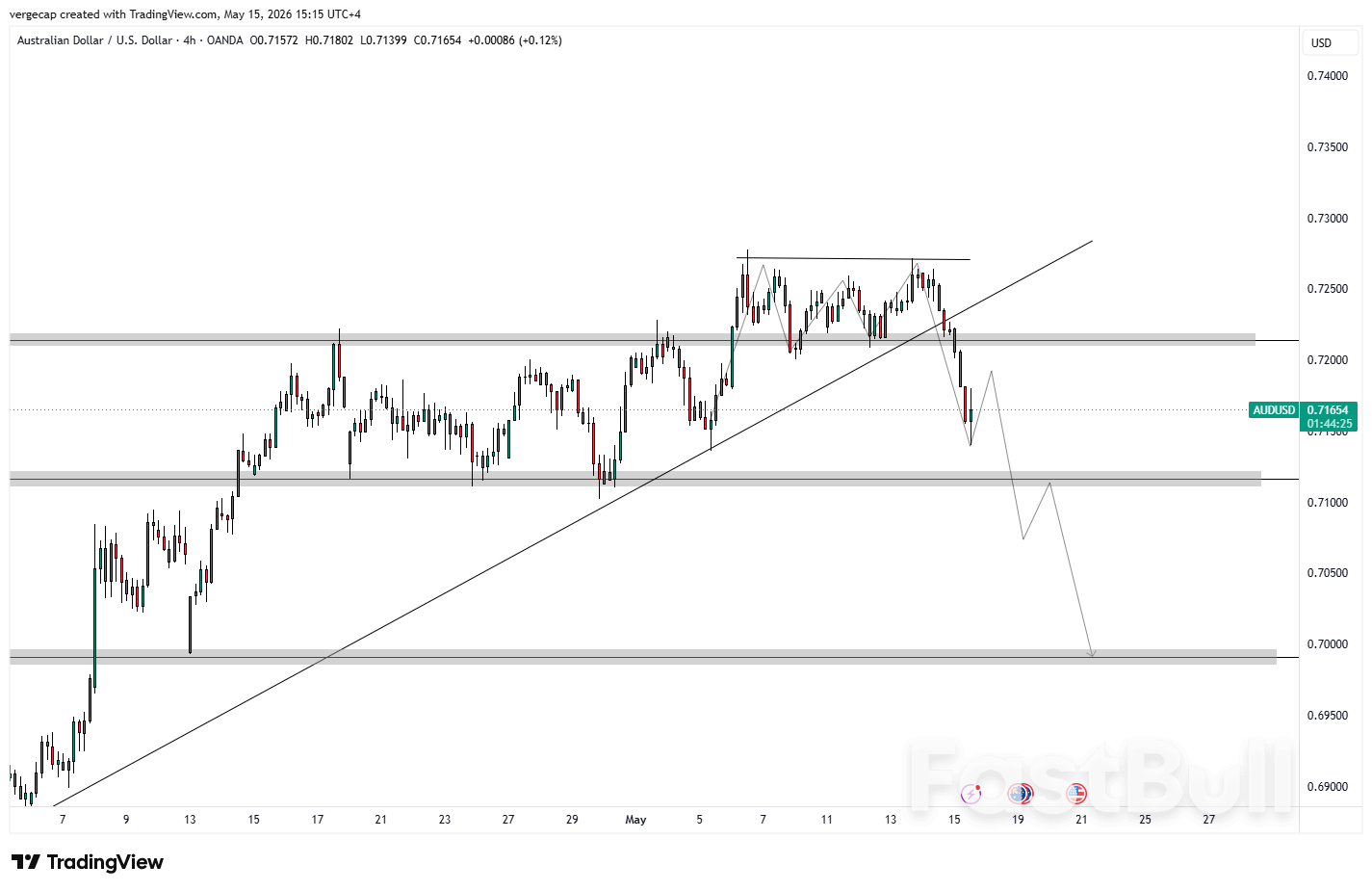
From a technical perspective, AUD/USD appears to be transitioning from a bullish recovery phase into a more vulnerable corrective structure after failing to sustain momentum above the 0.7250 resistance zone on the 4-hour chart. Price action recently broke below a well-defined ascending trendline that had supported the broader rally since early May, signaling weakening bullish momentum and increasing downside risks in the near term.
The pair is currently trading near the 0.7165 region after suffering a sharp rejection from the 0.7250–0.7265 supply zone, an area that repeatedly capped upside attempts over recent sessions. The inability of buyers to establish a sustained breakout above this resistance region suggests that bullish momentum has faded significantly, opening the door for a deeper retracement lower.
The breakdown below the rising trendline is technically significant because it confirms deterioration in the short-term market structure. Additionally, price has now slipped beneath the key 0.7200 psychological level, which previously acted as an important support-turned-resistance zone. As long as AUD/USD remains below this region, sellers are likely to retain near-term control.
Immediate support is now located near the 0.7110–0.7100 region, where previous consolidation and demand emerged earlier in the month. A sustained move below this area would likely accelerate bearish momentum and expose the next major downside target around the 0.7000 psychological handle. That level also aligns with a broader horizontal support zone visible on the chart and could become a key battleground between buyers and sellers.
Should bearish pressure intensify further, a decisive break beneath 0.7000 would confirm a broader trend reversal and potentially trigger a deeper decline toward the 0.6950 region. Such a move would mark a significant shift in sentiment after the pair’s strong recovery from April lows.
On the upside, bullish traders would need to reclaim the 0.7200 level decisively to stabilize near-term sentiment. A sustained recovery above this barrier could allow AUD/USD to retest the 0.7250 resistance zone. However, only a confirmed breakout above 0.7265 would invalidate the current bearish structure and shift focus back toward the 0.7300 region.
Momentum indicators are beginning to favor the bears. The Relative Strength Index (RSI) likely continues to drift lower toward neutral territory after previously approaching overbought conditions, suggesting bullish momentum has cooled considerably. This weakening momentum profile supports expectations for additional downside consolidation or corrective movement in the near term.
Meanwhile, the Moving Average Convergence Divergence (MACD) appears to be rolling over and approaching a bearish crossover near the zero line, reinforcing signs of slowing upside momentum and increasing probability of continued downside pressure.
TRADE RECOMMENDATION
SELL AUD/USD
ENTRY PRICE: 0.7180
STOP LOSS: 0.7225
TAKE PROFIT: 0.7000


