AUD/USD rose toward 0.7070 on Monday as improving risk sentiment following a US-Iran framework agreement weakened demand for safe-haven assets and pressured the US Dollar. Investors are now turning their attention to the Reserve Bank of Australia's policy decision and upcoming inflation data.
The Australian Dollar strengthened against the US Dollar on Monday, with AUD/USD climbing around 0.35% to trade near 0.7070 after the United States and Iran announced a framework agreement aimed at ending their long-running conflict.
The development sparked a broad risk-on move across global financial markets. US President Donald Trump stated that the Strait of Hormuz would be reopened as part of the agreement, while Iranian officials confirmed that negotiations were progressing and could be finalized in the coming days. Reports also indicated that the ceasefire in place since April would be extended to support further talks.
The easing of geopolitical tensions reduced demand for traditional safe-haven assets, weighing on the US Dollar. The US Dollar Index (DXY) slipped around 0.3% to trade near 99.50, while US equity futures advanced between 1% and 2% during the European session.
Oil prices were among the biggest movers, with West Texas Intermediate (WTI) crude falling roughly 5% as investors reassessed the risk of supply disruptions in the Middle East. In my view, the decline in oil prices is helping to ease concerns about a renewed inflation shock, reducing pressure on the Federal Reserve to maintain a restrictive policy stance and further weakening the Greenback.
The softer Dollar provided additional support for risk-sensitive currencies such as the Australian Dollar, which tends to benefit during periods of improving market sentiment and stronger global growth expectations.
Investors are now focused on Tuesday's Reserve Bank of Australia policy meeting, where the central bank is widely expected to leave interest rates unchanged at 4.35%. Markets will closely monitor comments from Governor Michele Bullock for signals on the future path of monetary policy.
Attention will also turn to Australia's May Consumer Price Index report due on June 24, which could play a key role in shaping expectations for future RBA decisions.
For now, the combination of easing geopolitical tensions, falling oil prices, and a weaker US Dollar continues to support AUD/USD, with traders watching whether the pair can extend gains above the 0.7070 level in the near term.
Technical Analysis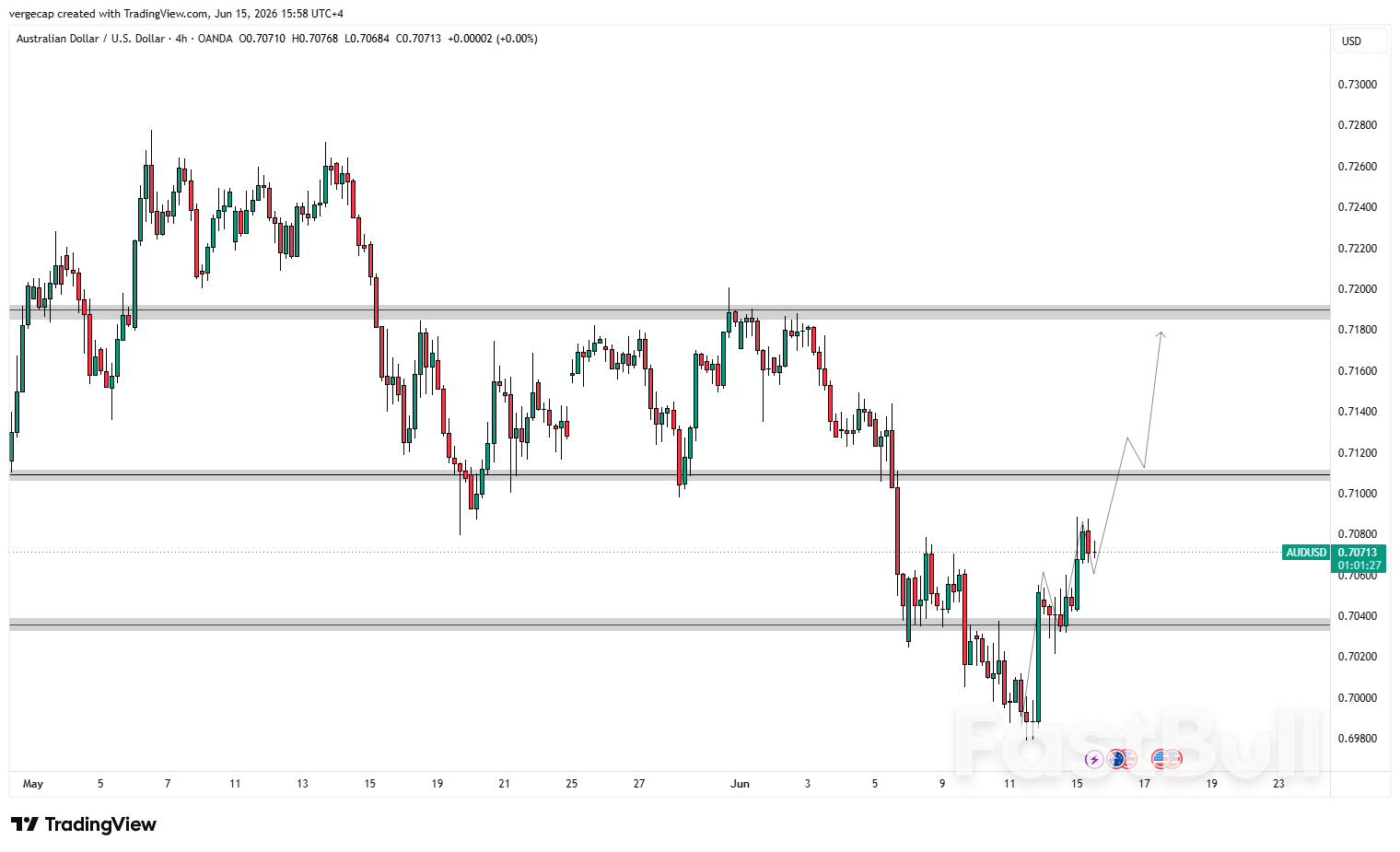
AUD/USD is showing signs of a developing bullish recovery after establishing a strong base near the 0.6990–0.7000 support zone on the 4-hour chart. The pair recently experienced a sharp bearish decline from the 0.7180 region, breaking below several key support levels before finding demand around the psychological 0.7000 handle. Since then, buyers have returned aggressively, producing a V-shaped rebound that has lifted prices back above 0.7070 and shifted short-term momentum in favor of the bulls.
The recovery has allowed AUD/USD to reclaim the 0.7040 support area, which previously acted as resistance during the recent consolidation phase. This level now serves as the first layer of support and is crucial for maintaining the current bullish recovery structure. As long as prices remain above this zone, buyers are likely to retain control of near-term price action.
The immediate upside focus is on the 0.7100–0.7110 resistance zone, a former support area that became resistance following the sharp breakdown earlier this month. A decisive break and sustained close above this barrier would confirm the strength of the current recovery and expose the next major resistance around 0.7180–0.7190. This area represents a significant supply zone where sellers repeatedly emerged throughout May and early June.
A successful move through 0.7190 would mark a notable improvement in market structure, potentially opening the door toward the 0.7240 region and eventually the May highs near 0.7260. Such a development would indicate that the recent selloff was corrective rather than the beginning of a broader bearish trend.
On the downside, initial support is located around 0.7040, followed by stronger support near 0.7000. The latter represents both a psychological level and the location of the recent swing low. A break below 0.7000 would invalidate the current recovery scenario and likely trigger renewed selling pressure toward 0.6980 and potentially lower levels. Such a move would re-establish the sequence of lower highs and lower lows that has dominated price action since late May.
From a market structure standpoint, the pair appears to be transitioning from a bearish phase into a corrective bullish recovery. The strong rejection from the 0.6990 area suggests that buyers view sub-0.7000 levels as attractive, while the recent breakout above short-term consolidation resistance indicates improving sentiment. However, the broader trend cannot be considered fully bullish until the pair successfully reclaims the 0.7100–0.7110 region and begins establishing higher highs on the 4-hour timeframe.
Although momentum indicators are not displayed on the chart, recent price action suggests strengthening bullish momentum. The sharp recovery from oversold conditions and the ability of buyers to maintain gains above reclaimed support levels indicate increasing upside pressure. Nevertheless, resistance overhead remains significant, which may result in periods of consolidation before the next directional move develops.
TRADE RECOMMENDATION
BUY AUD/USD
ENTRY PRICE: 0.7070
STOP LOSS: 0.7020
TAKE PROFIT : 0.7240


