The AUD/JPY currency cross extended its upward momentum for a third consecutive session on Wednesday, hovering near the 113.40 level during European trading hours, as improving global risk appetite and geopolitical developments combined to support the Australian Dollar while undermining demand for the Japanese Yen.
Market sentiment appeared buoyed by renewed optimism surrounding potential diplomatic engagement between the United States and Iran. Comments from Donald Trump injected fresh volatility into geopolitical expectations, after he indicated that a continuation of the current ceasefire arrangement was unlikely. In remarks made during an interview with ABC News, Trump suggested that developments in the coming days could be significant, hinting at a possible resumption of negotiations while simultaneously rejecting the idea of a prolonged suspension of Iran’s nuclear program.
From my perspective as a financial reporter, these mixed signals are precisely the kind of geopolitical ambiguity that tends to fuel risk-sensitive currencies like the Australian Dollar. Markets are not necessarily pricing in resolution, but rather trading on the possibility of de-escalation—however fragile that may be. This has provided the AUD with a tailwind, particularly against lower-yielding safe-haven currencies such as the Yen.
On the domestic front, however, Australia’s outlook remains far from straightforward. Reserve Bank of Australia Deputy Governor Andrew Hauser struck a notably cautious tone, warning that the months ahead could prove economically challenging. Speaking earlier this week, Hauser emphasized that the Australian economy is grappling with the dual pressures of persistent inflation and supply-side constraints, both exacerbated by ongoing tensions in the Middle East. He raised the specter of a stagflation-like environment—a troubling scenario where growth stagnates even as price pressures remain elevated.
In my view, this warning should not be underestimated. While the AUD is currently benefiting from external sentiment, its medium-term trajectory may become increasingly sensitive to domestic macroeconomic fragilities. If inflation remains sticky while growth slows, the policy flexibility of the RBA could become severely constrained.
Meanwhile, the Japanese Yen continues to struggle, weighed down by Japan’s structural vulnerability to rising energy costs. As a major importer of Middle Eastern oil, Japan faces significant headwinds from elevated crude prices. The recent uptick in oil has been driven by uncertainty surrounding supply routes, particularly through the strategically critical Strait of Hormuz, following reports of US military actions tightening maritime flows.
This dynamic has created a divergence: while higher commodity prices often support the Australian Dollar, they simultaneously pressure the Yen, amplifying upside in AUD/JPY. However, there are limits to this trend. Speculation around potential intervention by Japanese authorities remains a key risk factor for traders. Historically, sharp depreciation in the Yen has prompted action, and markets remain alert to any signals from Tokyo.
Adding to this caution, Kazuo Ueda of the Bank of Japan warned that policymakers must stay vigilant. He highlighted that rising energy prices could significantly weigh on Japan’s economic recovery, underscoring the delicate balance facing Japanese monetary authorities.
Technical Analysis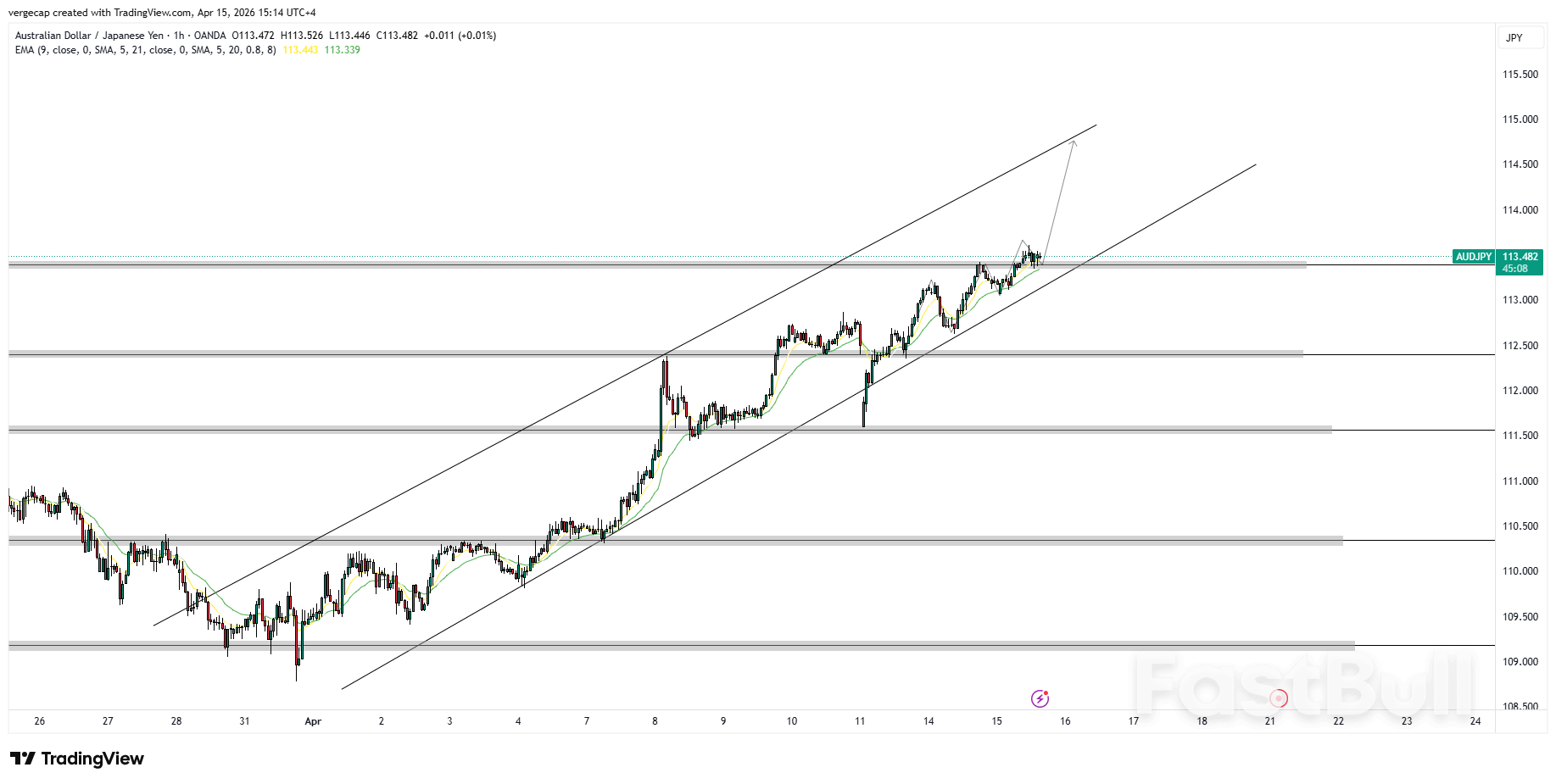
AUD/JPY remains firmly embedded within a well-defined bullish structure, with price action on the 1-hour chart advancing inside a clearly established ascending channel. The pair is currently trading near the upper boundary of this formation around 113.40, suggesting that bullish momentum remains intact, albeit with early signs of near-term consolidation as price compresses just below resistance.
The short-term moving averages, particularly the 9-period and 21-period SMAs, continue to track closely beneath price action and slope upward, reinforcing the strength of the ongoing trend. These dynamic supports—currently clustered around the 113.30–113.35 region—have consistently absorbed intraday pullbacks, indicating that buyers remain active on dips. As long as price holds above this zone, the immediate bullish bias remains structurally sound.
A more critical layer of support is seen near the mid-channel region around 112.80–112.50, which aligns with prior consolidation zones and horizontal structure. This area represents a key pivot for the broader trend. A decisive break below this region would signal a weakening of bullish control and could open the door for a deeper retracement toward the 112.00 handle, followed by the 111.50 zone, where previous demand emerged. A sustained move beneath these levels would mark a notable deterioration in trend structure and shift the outlook toward a more corrective phase.
On the upside, price is currently testing a near-term resistance band just above 113.50, which coincides with recent highs and the upper boundary of the ascending channel. A clean and sustained breakout above this region would confirm continuation of the bullish trend and likely accelerate momentum toward the 114.50 level in the near term. Beyond that, the projected channel extension points toward the 115.00 psychological barrier, which could act as a magnet for bullish positioning if momentum strengthens.
Momentum indicators, while not explicitly shown, can be inferred from price behavior to be moderating rather than reversing. The recent tightening in price action near highs suggests a pause in momentum rather than exhaustion. This type of consolidation near resistance typically favors continuation, provided support levels remain intact.
In my view, this is a classic trend continuation setup: higher highs, higher lows, and orderly price action within a rising channel. However, the proximity to resistance means traders should remain cautious of short-term pullbacks or false breakouts. The broader structure still favors buying on dips rather than chasing strength at resistance.
TRADE RECOMMENDATION
BUY AUD/JPY
ENTRY PRICE: 113.50
STOP LOSS: 112.40
TAKE PROFIT: 114.80


