AUD/JPY is inching higher during Wednesday's Asian session, trading around 114.10 after a flat previous session, lifted by a Bloomberg headline that delivered precisely the kind of diplomatic signal risk-sensitive currencies feed on. Tasnim News Agency — linked to Iran's Islamic Revolutionary Guard Corps — reported that Tehran had received "some sign" the United States may be willing to ease its naval blockade. Three words. That was enough to move the Australian Dollar and lift the cross from its overnight lows.
That is the nature of trading in a geopolitically dominated market. Every fragment of diplomatic progress, however tentative and unconfirmed, is amplified by a market desperate for reasons to rotate back into risk assets. Whether this particular signal survives contact with reality is another matter entirely.
President Trump confirmed an open-ended ceasefire extension tied to "tangible progress" in negotiations — a formulation that gives Washington maximum flexibility to define terms at will. But US Treasury Secretary Scott Bessent simultaneously confirmed that the Navy will continue enforcing restrictions on Iranian ports to curtail Tehran's revenue streams. The same morning that markets rallied on blockade-easing signals, the Treasury Secretary reaffirmed the blockade's continuation without qualification.
That contradiction — one hand signalling flexibility, the other confirming the status quo — is the defining feature of the current diplomatic landscape, and it should give AUD/JPY bulls genuine pause. A market that prices in optimism and then rediscovers that nothing has fundamentally changed is a market vulnerable to rapid and painful reversal.
The most strategically significant development of the session received less immediate attention than the headline: the UK Defence Ministry confirmed that military planners from more than 30 nations will convene in London for two days to advance plans for reopening the Strait of Hormuz and finalise operational details. This is not diplomacy. This is a military planning conference — a signal that force remains very much on the table as a mechanism of last resort and that the international community is no longer willing to wait indefinitely for a negotiated resolution.
West Texas Intermediate is declining nearly 1.5% on Wednesday, trading around $88.30 per barrel — a move that provides the Japanese Yen with modest but meaningful support rooted in Japan's extraordinary structural vulnerability to energy prices. Japan imports the vast majority of its crude from Middle Eastern producers, meaning every dollar decline in oil translates directly into trade balance relief and reduced inflationary pressure on Japanese households and industry.
The relief is sufficient to keep the Yen firm enough to limit AUD/JPY's upside, without being large enough to drive the cross materially lower. Japan's trade data added nuance to the picture. Exports rose 11.7% — beating the 11.0% forecast for a seventh consecutive month on robust demand from China and ASEAN — a genuinely impressive streak reflecting structural competitiveness in Japan's export sector. The disappointment came from the trade surplus, which printed at JPY 667 billion against a projected JPY 1,106 billion. The gap tells the story precisely: export revenues are growing, but elevated energy import costs are growing faster, compressing the surplus to levels that highlight the ongoing energy squeeze at the heart of Japan's economic challenge.
The Bank of Japan's April 28 meeting is, at this point, a foregone conclusion — rates stay at 0.75%, the inflation forecast goes up, the growth forecast comes down, and the central bank issues the kind of carefully balanced statement that commits to nothing while acknowledging everything. The more consequential question is whether the BoJ uses the meeting to credibly signal a return to policy normalization as early as June. Reports suggest it may. If that signal lands with conviction, the Yen has a genuine fundamental floor to rally from. If it is buried under qualifications and conditionality — which given the current environment seems more likely — the structural Yen weakness that has underpinned AUD/JPY's elevated positioning will persist.
Technical Analysis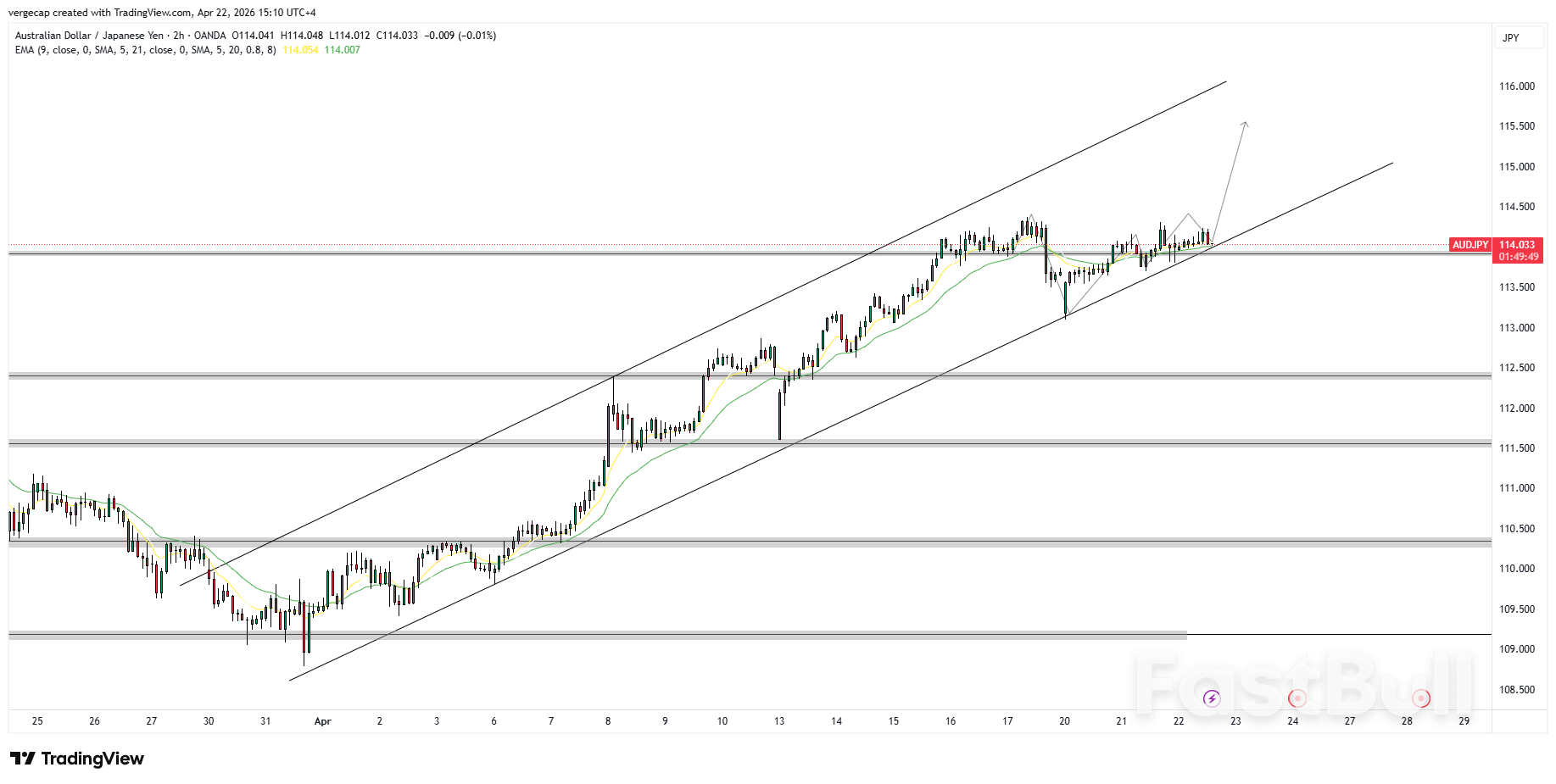
UD/JPY is deeply entrenched within a well-defined and structurally impressive ascending channel on the 2-hour chart — a formation that has guided price higher with remarkable consistency since the early April lows near 109.00. The channel is clean, well-proportioned, and has been respected on both its upper and lower boundaries across multiple tests, lending it a degree of technical credibility that demands the bullish bias be treated as the primary directional scenario until the structure is meaningfully violated.
Price currently trades at 114.033, consolidating just beneath the upper boundary of the ascending channel and the 114.20–114.30 horizontal resistance zone that has capped recent intraday advances on multiple occasions. Both the 9-period EMA at 114.054 and the 21-period SMA at 114.007 are running in near-perfect convergence directly beneath current price — a tight clustering that reflects a market pausing for breath within a trend rather than one undergoing a structural reversal. This configuration, where price sits fractionally above tightly converged moving averages within an ascending channel, is among the most constructive consolidation setups available on an intraday chart and typically resolves in the direction of the prevailing trend.
The lower boundary of the ascending channel, currently intersecting near the 113.20–113.40 area, represents the first and most critical layer of dynamic support. This boundary has been tested twice in recent sessions — most notably around April 17 and again around April 20 — and each test produced a sharp and confident bullish rejection, confirming that institutional buyers are defending the channel floor with conviction. A sustained 2-hour close below the channel's lower boundary would represent a meaningful structural deterioration and would shift the near-term bias from bullish to neutral at minimum. Should such a breakdown occur, the 112.50 horizontal support band — visible as a prominent gray zone on the chart — would become the next downside reference, followed by the 111.50 area where prior consolidation from early April provided a meaningful base.
The 114.20–114.30 resistance zone immediately overhead is the pair's primary near-term obstacle. This level has acted as a ceiling on multiple 2-hour closes in recent sessions, and a clean, sustained break above it — particularly if accompanied by a push through the upper channel boundary near 114.50 — would be the technical trigger for the next impulsive leg higher. The projected path drawn on the chart targets the 115.30–115.50 area as the primary upside objective, consistent with the measured move derived from the channel's width applied to the upper boundary breakout point. Beyond that, the 116.00 level represents the broader medium-term target and a psychologically significant round number that would attract both speculative and momentum-driven positioning.
The moving average configuration reinforces the bullish thesis. Both the 9-period EMA and 21-period SMA are sloping gently upward in parallel formation beneath price — the textbook alignment of a healthy trending market consolidating within its structure rather than topping. The fact that the pair has remained above both averages throughout the current consolidation phase confirms that dip-buyers continue to dominate the near-term price action and that sellers lack the conviction to generate meaningful follow-through to the downside.
The overall structure — a well-defined ascending channel, tightly converged bullish moving averages, a series of higher lows validating channel support, and a projected extension toward 115.50 — presents one of the cleanest technically bullish setups currently visible on the 2-hour timeframe across the major Yen crosses.
TRADE RECOMMENDATION
BUY AUD/JPY
ENTRY PRICE: 114.05
STOP LOSS: 113.10
TAKE PROFIT: 115.50


