The Australian Dollar continued its measured recovery against the Yen on Wednesday, with the AUD/JPY cross climbing for a second consecutive session to trade near 110.10 during European hours. The modest upside was driven by a palpable easing in geopolitical anxiety in the Middle East, which buoyed risk-sensitive assets and allowed the Aussie to shrug off persistent concerns regarding elevated energy costs and a clouded monetary policy outlook in Canberra.
The primary catalyst for the recent rebound in the Australian Dollar appears to be a tangible thaw in hostilities between the United States and Iran. President Donald Trump signaled a definitive shift in US strategy on Tuesday, stating that American forces would be “leaving very soon” from the conflict zone, projecting a full withdrawal within the next two to three weeks. In a notable departure from prior hardline rhetoric, Trump also indicated that a formalized agreement with Tehran was not a prerequisite for ending the military engagement.
This sentiment was reciprocated by Iranian President Masoud Pezeshkian, who expressed a conditional willingness to de-escalate regional tensions, provided specific—though undisclosed—guarantees are met. The prospect of a swift cessation to the conflict has prompted traders to unwind some of the safe-haven flows that had bolstered the Yen in recent weeks, restoring a modicum of confidence in pro-cyclical currencies like the Aussie.
Despite the geopolitical relief, the structural fallout from the months-long conflict continues to reverberate through the Australian economy, creating a complex headwind for the Reserve Bank. Elevated energy prices—a direct consequence of supply chain disruptions in the Persian Gulf—are proving stubbornly persistent. For the RBA, this is an unwelcome development. Analysts warn that the pass-through from higher fuel and energy costs is keeping headline inflation elevated for longer than anticipated, effectively constraining the central bank’s ability to pivot toward a neutral or dovish stance.
The market has responded aggressively to this dynamic. Interest rate futures are now pricing in a 64% probability of a rate hike to 4.35% at the RBA’s next board meeting. This hawkish repricing is a double-edged sword for the Australian Dollar. While higher yields typically support a currency, the market is increasingly concerned that the RBA may be forced to tighten into a slowing external backdrop. The ASX 30 Day Interbank Cash Rate Futures contract for May 2026 was last seen trading at 95.765, reflecting the market’s conviction that the central bank’s next move is likely up.
The economic data released Wednesday painted a picture of diverging fortunes for the Pacific region. In a concerning sign for Australia’s largest export market, China’s manufacturing sector showed signs of strain. The RatingDog Manufacturing Purchasing Managers’ Index (PMI) eased to 50.8 in March, down from 52.1 in February and missing consensus forecasts of 51.6. The slowdown was attributed primarily to rising energy costs squeezing margins for Chinese manufacturers, suggesting that the demand for Australian raw materials may face headwinds in the coming months.
Conversely, Australia’s own terms of trade received a significant boost. The RBA Commodity Index SDR—a key measure of the nation’s export prices—jumped 12.8% year-over-year in March. This represents the strongest annual increase since January 2023 and marks a substantial acceleration from the revised 4.9% gain recorded in the previous month. The surge, largely driven by energy and iron ore prices, suggests that Australia’s national income remains robust, providing a fundamental backstop for the currency even as domestic consumption slows.
On the other side of the equation, the Japanese Yen is finding underlying support from a domestic economy that is finally showing sustainable signs of normalization. The Bank of Japan’s closely watched Tankan survey for the first quarter delivered a positive surprise, with the Large Manufacturing Index rising to 17. This marks the fourth consecutive quarter of improvement, up from a revised reading of 16 and beating analyst expectations.
The data reinforces the BoJ’s cautious but firm stance that the economy is on a path to sustainably meet its 2% inflation target. Governor Kazuo Ueda has consistently signaled that gradual rate hikes are on the table, a message that is now being validated by hard data. While the BoJ’s pace of tightening remains glacial compared to its Western peers, the consistent improvement in sentiment indicators provides a floor for the Yen, preventing the AUD/JPY cross from staging a more aggressive rally.
Technical Analysis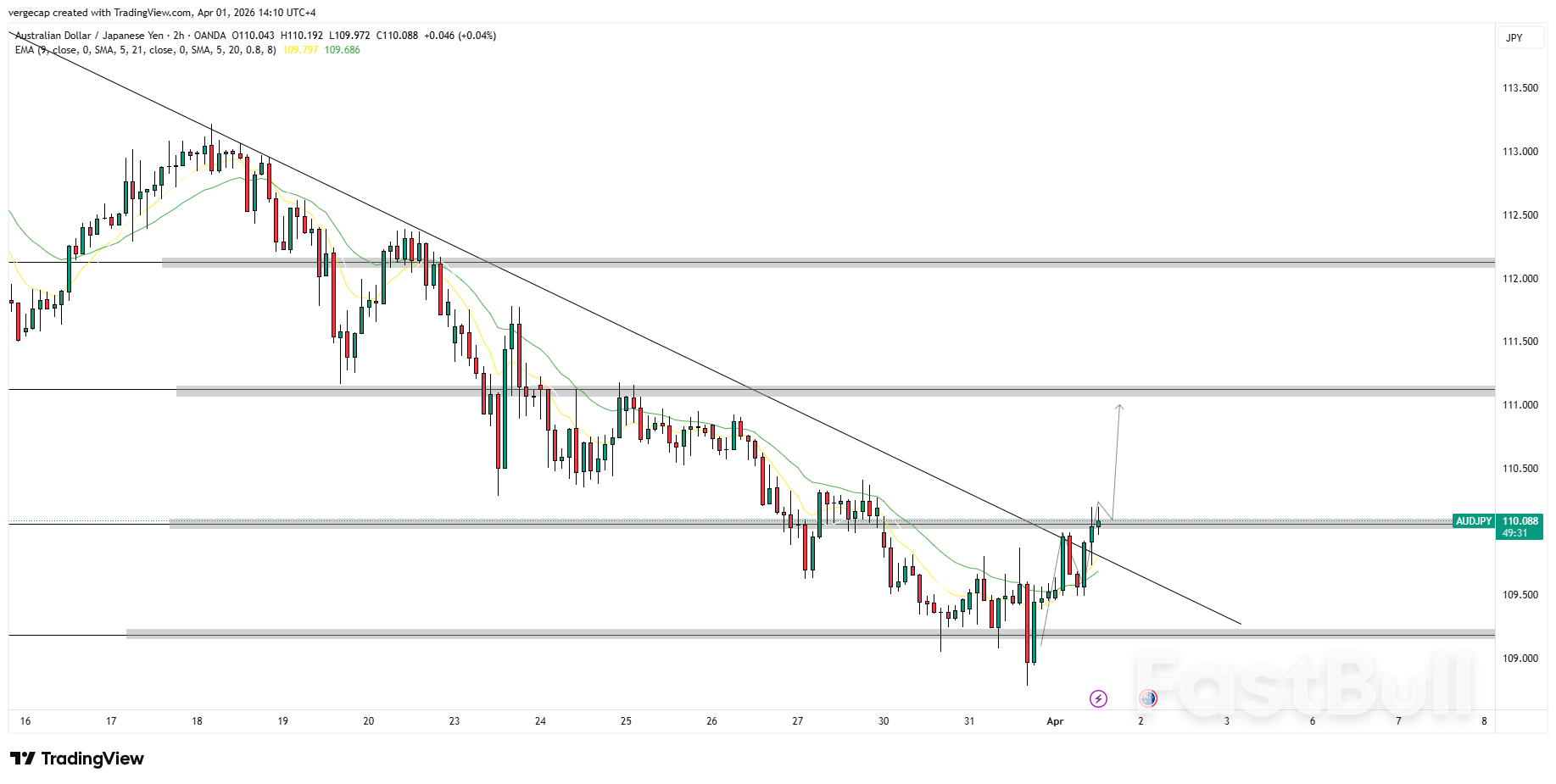
From a technical perspective, AUD/JPY remains trapped within a dominant and well-defined descending trendline structure on the 2-hour chart that has guided price relentlessly lower since the 113.20 highs of March 18 — a decline of more than 400 pips that has systematically dismantled every attempted recovery and cemented the bearish trend as the overriding technical reality for this cross. However, the most recent price action introduces a genuinely interesting technical inflection, with the pair staging a sharp recovery from the 109.00 support floor and now challenging the descending trendline from below for the first time in nearly two weeks — a moment that demands close attention from both bulls and bears alike.
The descending trendline, drawn connecting the March 18 peak at 113.20 through the successive lower highs of March 20, 24, and 26–27, has acted as an impenetrable ceiling throughout the entire corrective phase. Every attempted recovery into this trendline has been met with aggressive selling, producing a textbook sequence of rejection candles that reinforced the integrity of the bearish structure. Price is now, for the first time, testing this trendline near the 110.10–110.15 area — and crucially, the test is occurring in the context of a sharp and momentum-driven recovery from the 109.00 lows, which adds a degree of bullish credibility to the current attempt that previous rallies did not possess.
The 9-period EMA at 109.80 and the 21-period SMA at 109.69 have both begun to curl upward following the violent snapback from the 109.00 floor, and price is now trading above both averages for the first time since the early stages of the downtrend. This moving average crossover beneath a rising price is a preliminary — though not yet confirmed — signal that short-term momentum is beginning to rotate in favor of the Australian Dollar. The fact that both averages are converging near the 109.70–109.80 area creates a dynamic support cluster that should contain any near-term dip and maintain the recovery's structural integrity.
The 109.20–109.30 horizontal support zone proved critical during the March 31 to April 1 washout, holding price above the psychologically significant 109.00 handle after a brief and dramatic spike lower to approximately 108.90. The violence of that spike — followed immediately by an equally aggressive recovery — has the hallmarks of a stop-hunt or climactic selling event, the kind of price action that frequently marks at least a short-term exhaustion of the prevailing trend. The strength and speed of the subsequent bounce back through 109.70, 109.80, and ultimately to 110.00 in rapid succession reinforces the view that the 109.00 area represents a powerful demand zone and that the immediate selling pressure has been absorbed.
The critical test now sits directly overhead. A decisive 2-hour close above the descending trendline near 110.15–110.20 would represent the most significant technical development on this chart since the downtrend began — a genuine trendline breakout that would shift the near-term bias from bearish to neutral-to-bullish and open the door toward the 111.00–111.10 horizontal resistance zone, the first major structural target on any sustained recovery. The projected move arrows on the chart align precisely with this target, suggesting the market itself is eyeing this level as the natural destination of the current bounce. A subsequent break above 111.00 would bring the 112.00–112.10 major resistance ceiling — the dominant horizontal supply zone that capped the pair on March 19–20 before the accelerated decline — into realistic play.
However, caution is warranted. The descending trendline has been respected with remarkable consistency throughout the entire corrective phase, and a failure to break above it cleanly — defined by a 2-hour close back below the trendline near 110.00 after an initial spike through it — would represent a classic false breakout scenario and a high-probability signal for renewed selling pressure. In that case, the 109.30–109.50 support band would be the first downside target, and a failure there would re-expose the 109.00 psychological floor and ultimately the 108.60–108.70 area below it.
The weight of evidence on this chart still favors caution over aggressive bullish positioning. The dominant trend remains lower, the descending trendline has not yet been convincingly broken, and the recovery — while sharp — has occurred from deeply oversold conditions that often produce violent but ultimately temporary counter-trend moves. Confirmation of a genuine trendline breakout on a closing basis is essential before committing to a sustained bullish view.
TRADE RECOMMENDATION
BUY AUD/JPY
ENTRY PRICE: 110.20
STOP LOSS: 109.20
TAKE PROFIT: 111.10


