The Australian Dollar is managing a fragile advance against its Canadian counterpart in Friday’s European trade, but the cross’s path forward is mired in a complex tug-of-war. As of this writing, AUD/CAD is trading around 0.9520, having clawed back its earlier daily declines to remain in positive territory for the session. However, this modest strength masks underlying tensions. The pair’s upside appears fundamentally capped by a commodity-linked Canadian Dollar drawing direct sustenance from a firmer crude complex, while the Aussie’s own recovery is being tested by a souring global risk mood and its own domestic policy nuances.
The immediate anchor for the Loonie is the steadying drumbeat in the oil markets. West Texas Intermediate (WTI) crude is trading near $74.00 per barrel, advancing after a modestly soft previous session. Yet, this intraday firmness belies a more cautionary weekly narrative: the benchmark is poised to snap a remarkable six-week winning streak. The primary weight on the weekly chart is the looming shadow of geopolitics and its implications for global supply. All eyes are trained on the anticipated meeting between United States and Iranian officials scheduled later today. For traders, the calculus is straightforward: any tangible progress in these talks could significantly de-escalate near-term fears of a broader military conflict in a region critical to global energy flows. Given that the involved OPEC producer accounts for approximately one-third of the world’s crude output, a diplomatic thaw could swiftly alleviate premium priced into the market over potential supply disruptions, applying persistent pressure on prices and, by extension, the commodity-correlated CAD.
However, the Australian Dollar’s journey this session has been its own rollercoaster, largely detached from direct commodity fortunes and instead tied to the whims of global equities and central bank rhetoric. The AUD, widely regarded as a liquid barometer for global risk appetite, found itself squarely in the crosshairs of a broad-based sell-off in risk-sensitive assets. The trigger was a palpable anxiety permeating equity markets, particularly within the technology sector. Investor confidence was notably unsettled by mounting concerns over the immense capital expenditure required for artificial intelligence infrastructure, leading to a tech-led equity rout that spilled over into currency markets. This flight from risk prompted a distinct weakening in the Aussie against its major peers earlier in the day.
Yet, the narrative took a decisive turn following commentary from Reserve Bank of Australia Governor Michele Bullock. In a pointed assessment of the economic landscape, Governor Bullock provided a clear rationale for the board’s recent decision to raise the Official Cash Rate. She stated unequivocally that the Australian economy is "more capacity-constrained than previously assessed," a condition necessitating a tighter policy stance to prevent overheating. Her remarks carried a further warning: the RBA stands ready to curb demand growth unless the nation’s productive capacity—its supply side—expands at a more rapid clip. This hawkish tilt, emphasizing persistent inflation risks and a commitment to restrictive policy, served as a lifeline for the AUD, allowing it to recoup losses not just against the USD but across crosses like the AUD/CAD.
The dichotomy is stark. On one side, the CAD draws strength from an oil market balancing on a geopolitical knife’s edge. On the other, the AUD is being pulled between a risk-off wave emanating from equity markets and a domestic central bank firmly signaling that its inflation fight is far from over. This sets the stage for a critical North American session, where the Canadian Dollar will face its own domestic litmus tests.
Market participants are now positioning for the release of Canada’s January labor market data and the Ivey Purchasing Managers’ Index (PMI). These indicators will provide crucial insight into the health of the Canadian economy and the potential trajectory for Bank of Canada policy. A robust jobs report and a resilient PMI reading could reinforce the BoC’s patient stance on rate cuts, further empowering the Loonie and applying renewed downward pressure on the AUD/CAD cross. Conversely, signs of softening could see the CAD relinquish some of its oil-powered gains.
Technical Analysis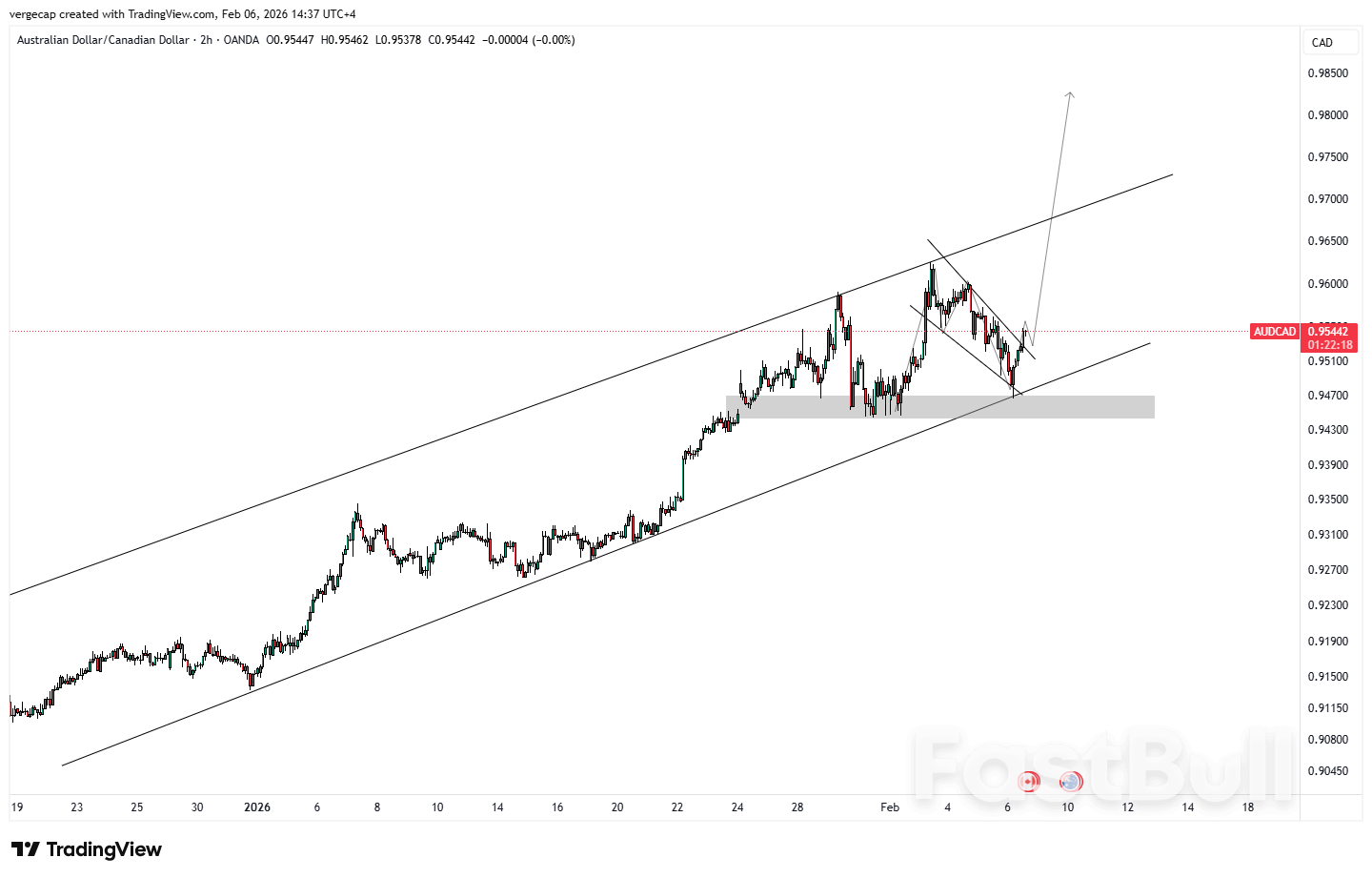
From a technical perspective, AUD/CAD remains positioned within a well-defined bullish channel, with recent price action suggesting a corrective pullback inside a broader uptrend. On the 2-hour chart, the pair continues to respect the rising channel structure that has guided price higher since late January, characterized by a sequence of higher highs and higher lows.
The latest decline appears to be a measured correction rather than a trend reversal, with price pulling back toward the lower boundary of the ascending channel. This pullback also aligns with a key horizontal demand zone around 0.9460–0.9480, which previously acted as resistance before being broken and now serves as support. The confluence of rising trendline support and horizontal demand strengthens this area as a technically significant base.
As long as price holds above this support cluster, the broader bullish structure remains intact. A sustained break below 0.9460, especially if accompanied by a move under the channel support, would signal a deterioration in momentum and open the door for a deeper retracement toward 0.9400 and potentially 0.9350, where the next structural support is located. Such a move would shift the outlook from bullish continuation to a more extended consolidation phase.
On the upside, immediate resistance is seen near 0.9600–0.9620, an area where recent rebounds have stalled. A decisive push above this region would confirm that the pullback has likely completed and that buyers are regaining control. Beyond that, the upper boundary of the rising channel comes into focus near 0.9700, followed by a projected extension toward 0.9800, in line with the bullish path illustrated on the chart.
The recent formation of a higher low near channel support suggests that buying interest is emerging on dips. Price compression following the pullback indicates that momentum may be rebuilding for another leg higher, rather than signaling distribution at the top.
Overall, the technical structure favors a buy-on-dips approach while AUD/CAD holds above the 0.9460 support zone and within the ascending channel.
TRADE RECOMMENDATION
BUY AUD/CAD
ENTRY PRICE: 0.9545
STOP LOSS: 0.9450
TAKE PROFIT: 0.9700


