It was always going to take something significant to knock the Aussie off its perch, and Wednesday’s blockbuster Nonfarm Payrolls print may have done just that — at least temporarily.
The AUD/USD pair slipped from fresh cycle highs of 0.7147, a level not visited since early 2023, as the US Dollar found its footing following a January jobs report that delivered more than a few surprises. Net employment growth of 130,000 nearly doubled consensus estimates of 70,000, providing an immediate jolt to Treasury yields and forcing a modest recalibration of Fed expectations.
But here’s where the narrative gets interesting — and where traders should exercise caution.
Beneath the headline strength, the composition of US employment gains raises legitimate questions about sustainability. A disproportionate share of hiring was concentrated in the healthcare sector, while the simultaneous downward revision to 2025 payrolls data suggests the underlying labour market trajectory may be less robust than January’s figure implies. The market’s relatively muted reaction tells you everything you need to know: nobody is prepared to fade the dollar aggressively ahead of Friday’s CPI report, but neither is anyone convinced that this marks the beginning of a sustained USD reversal.
While US data dominates the near-term headlines, the structural forces driving the Aussie higher remain very much intact. If anything, they’re intensifying.
The Melbourne Institute’s latest reading on Australian Consumer Inflation Expectations landed at 5.0% for February, up from 4.6% in January and marking the highest level in almost three years. This is not merely an abstract statistical exercise — these are real expectations filtering into wage negotiations, pricing decisions, and ultimately, household behaviour.
For the Reserve Bank, the message could not be clearer.
Last week’s 25-basis-point hike marked the RBA’s first tightening move in over two years, but Governor Bullock was emphatic on Thursday that this is unlikely to be a one-and-done affair. Her carefully calibrated language — affirming that “the door remains open” while simultaneously expressing a preference to “wait for the data” — reflects a central bank that understands it has fallen behind the curve and is now racing to restore its inflation-fighting credibility.
The divergence with the Federal Reserve is stark. Since markets began pricing the RBA’s hawkish shift four weeks ago, AUD/USD has surged 6.6% — one of the most violent policy repricing episodes we’ve witnessed in G10 FX this cycle.
This is the heart of the matter. While the RBA is contemplating how many more hikes are required to drag inflation back to its 2% target, the Fed finds itself in an entirely different predicament: trying to calibrate the precise timing and pace of rate cuts.
That asymmetry creates a powerful gravitational pull on the Aussie.
Yes, the US economy continues to churn out jobs at a respectable clip. Yes, Powell & Co. have pushed back against aggressive easing bets. But the directional bias of monetary policy across the Pacific remains fundamentally opposed. The RBA is tightening into an inflation shock; the Fed is preparing to normalise into a slowing economy.
Until that dynamic shifts, any USD rallies are likely to attract sellers.
Friday’s US Consumer Price Index report now assumes outsized importance. A hot print could force markets to unwind additional Fed easing expectations, potentially extending the dollar’s rebound and testing the Aussie’s resolve above 0.7100. Conversely, a benign reading would reaffirm the prevailing policy divergence narrative and likely see the AUD resume its upward trajectory.
Technical Analysis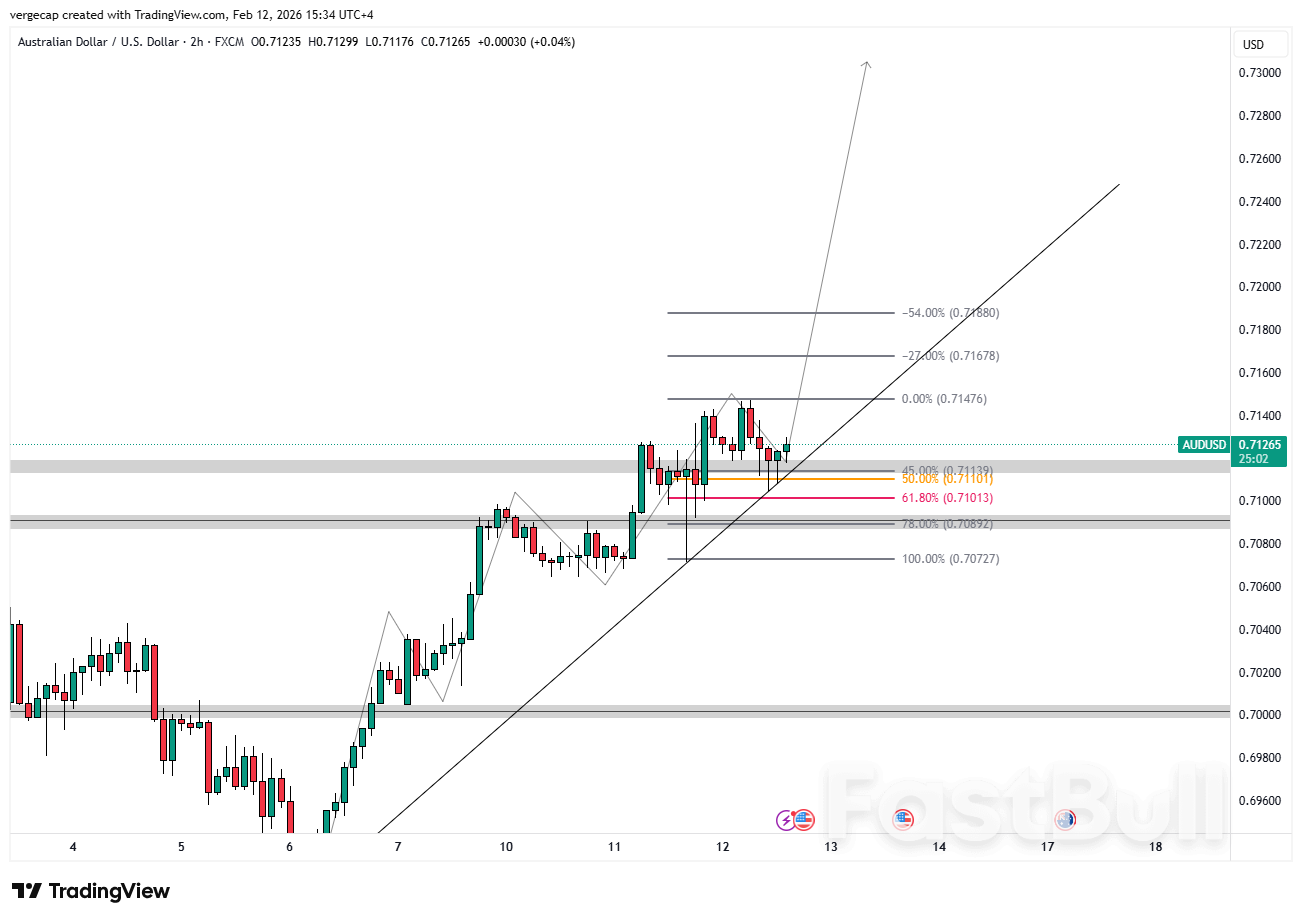
From a technical perspective, AUD/USD remains positioned within a developing bullish continuation structure on the 2-hour chart, with price action respecting a rising trendline that has guided the advance from the 0.7000 region. The pair recently completed a strong impulsive leg higher and is now consolidating in a controlled pullback, holding above key Fibonacci retracement levels — a classic sign of trend digestion rather than reversal.
The most recent swing high formed near 0.7145–0.7150, after which price eased into a retracement phase. The pullback has so far been contained within the 45%–61.8% Fibonacci retracement zone (0.7114–0.7101). This region overlaps with prior intraday structure and sits just above the ascending trendline, creating a confluence support area. As long as price holds above this band, the broader bullish structure remains intact.
The 50% retracement at 0.7110 is currently acting as the immediate pivot. Repeated wicks into this zone suggest buyers are defending the level. A deeper move toward the 61.8% retracement at 0.7101 would still be considered technically healthy within the context of the uptrend. However, a sustained break below this level would weaken short-term momentum and expose the 78.6% retracement near 0.7080, followed by the 0.7075–0.7080 structural support zone. A decisive breakdown beneath that region would signal a loss of trendline support and suggest a broader corrective phase toward 0.7000.
On the upside, bullish continuation hinges on a clean break above 0.7147 (recent high). A sustained push through this resistance would confirm the end of the pullback and likely accelerate gains toward the projected extension targets at 0.7168 (−27% extension) and 0.7188 (−54% extension). Beyond that, the broader ascending trajectory opens room toward the 0.7250–0.7300 zone, in line with the rising channel projection shown on the chart.
Structurally, the market is displaying higher highs and higher lows, supported by the upward-sloping trendline that continues to act as dynamic support. The consolidation phase appears orderly, indicating profit-taking rather than aggressive selling pressure. This behavior typically precedes continuation in trending environments.
Overall, AUD/USD maintains a constructive technical outlook while above 0.7100, with the current dip representing a potential higher-low formation within an ongoing bullish leg.
TRADE RECOMMENDATION
BUY AUD/USD
ENTRY PRICE: 0.7120
STOP LOSS: 0.7095
TAKE PROFIT: 0.7188


