The Australian Dollar emerged as the undisputed outperformer in the G10 space on Wednesday, extending its relentless recovery against a suddenly beleaguered US Dollar. The AUD/USD pair climbed decisively into the mid-0.6900s, building on a sharp rebound from Tuesday’s lows near 0.6833, as a dramatic shift in geopolitical sentiment unleashed a wave of risk appetite across global markets.
The catalyst for the about-face was a series of remarks from former US President Donald Trump, who injected a dose of optimism into the conflict-ravaged Middle East. Trump affirmed on Tuesday that he is planning to bring the war in the region to a close within the next two to three weeks, even in the absence of a formal deal with Tehran. In a statement that sent shockwaves through commodity and currency markets, he also predicted that the strategically vital Strait of Hormuz—a chokepoint for global oil flows—would be reopened “automatically” once the attacks cease.
For markets, the prospect of a swift de-escalation was enough to trigger a violent re-pricing of risk assets. The relief rally was immediate and broad-based: Asian equities closed with robust gains, while European benchmarks surged, with most major indexes posting advances of nearly 2% by the European afternoon. Wall Street futures were firmly in the green, signaling a strong open later in the day. In the classic “risk-on” playbook, capital fled the safety of the US Dollar and poured into higher-yielding, cyclical currencies like the Aussie. Concurrently, oil prices tumbled as the geopolitical risk premium evaporated, further alleviating pressure on energy-importing nations.
The Australian unit’s ascent has been particularly impressive given the conflicting signals emanating from the domestic economy. The currency’s recovery appeared virtually unfazed by a mixed bag of data releases on Wednesday that otherwise might have given traders pause.
On the one hand, Building Permits data for February smashed expectations, posting a robust rebound that suggested the beleaguered construction sector may be finding a floor. However, this optimism was swiftly tempered by the latest S&P Global Manufacturing Purchasing Managers’ Index (PMI). The print confirmed that the manufacturing sector remains in contractionary territory, with the ongoing Middle East conflict—and its associated supply chain disruptions—taking a heavy toll on activity. This dichotomy underscores the delicate balancing act facing the Reserve Bank of Australia (RBA). While the hawkish-leaning minutes from the RBA’s March policy meeting suggested the central bank remains wary of inflation, the softening real economy signals that the path to further tightening is far from straightforward.
Looking ahead, the narrative for the remainder of the week shifts firmly back to the US economic calendar. Wednesday’s session is packed with high-impact releases that are likely to set the table for the marquee event on Friday: the Nonfarm Payrolls report.
The market is bracing for the ADP Employment Change report and the ISM Manufacturing PMI for March, alongside Retail Sales figures for February. The latter will be particularly scrutinized for clues on the health of the American consumer. However, the real focus is on Friday’s jobs data. Following February’s shock 92,000 decline in net jobs—a figure that raised eyebrows about a potential slowdown in the labor market—economists are forecasting a solid rebound. If the data prints as expected, it could reaffirm the resilience of the US economy, potentially offering some support to the beleaguered Dollar. Conversely, a miss could accelerate the Greenback’s recent decline, giving the AUD/USD pair a clear runway to challenge the psychological 0.7000 barrier.
Technical Analysis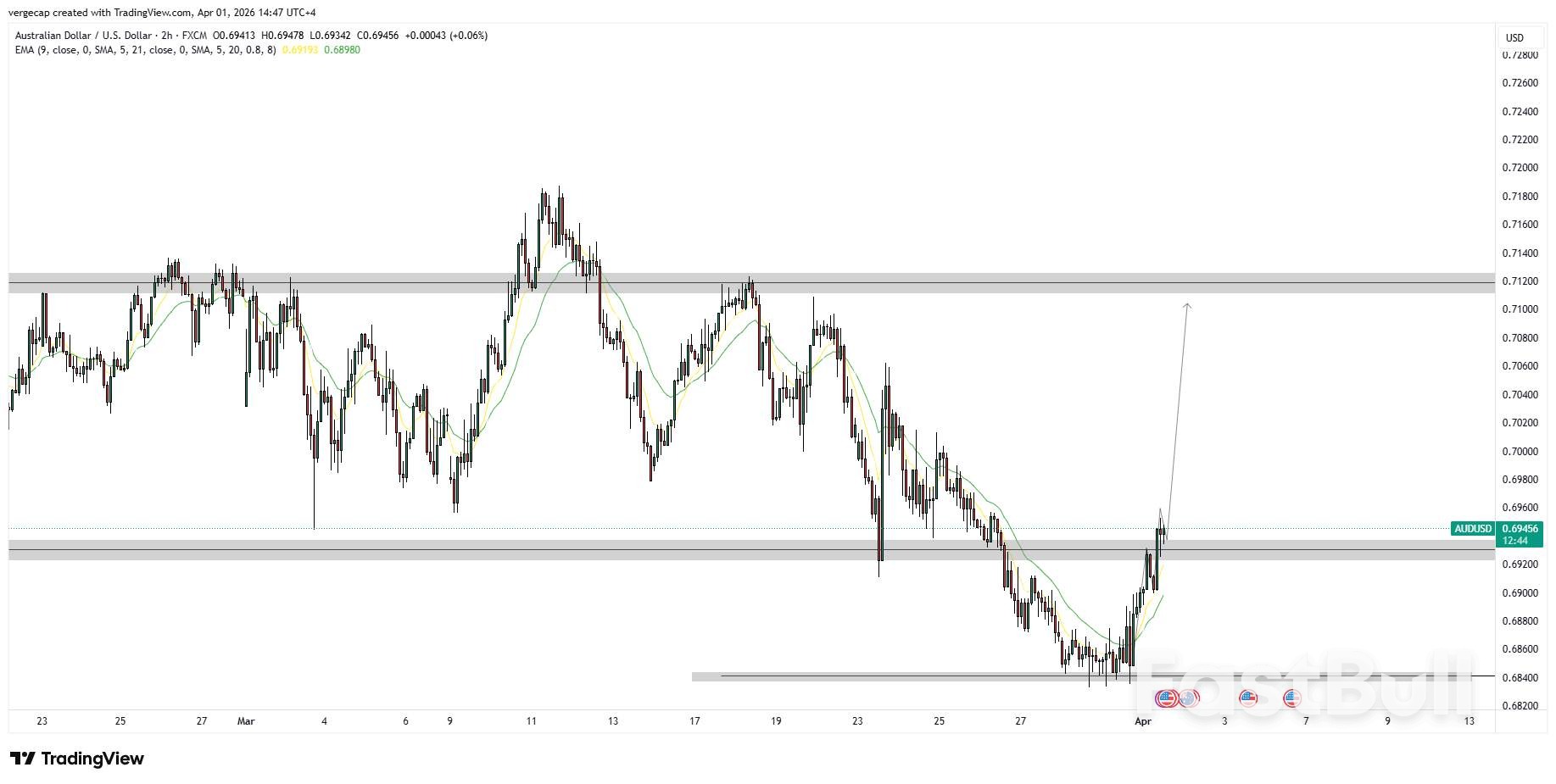
From a technical perspective, AUD/USD is carving out a compelling and potentially explosive bullish reversal structure on the 2-hour chart, with price staging a powerful recovery from the 0.6840 major support floor that has now reclaimed the critical 0.6920–0.6930 horizontal resistance band and is building momentum toward a much more significant upside objective. After enduring one of the most sustained and punishing declines seen on this chart — a relentless selloff from the 0.7180 highs of March 11 all the way down to the 0.6840 support base by late March, a collapse of approximately 340 pips — the Australian Dollar is finally showing signs that the selling pressure has been comprehensively exhausted and that a meaningful trend reversal is now underway.
The 0.6840–0.6850 support zone proved to be the decisive floor. Price tested this area multiple times during the March 27–April 1 period, producing a series of long lower wicks and hammer-like candle formations that collectively signal strong absorption of selling pressure and the emergence of institutional demand at this level. The inability of bears to sustain any close meaningfully below 0.6840 — despite repeated attempts — is a technically significant development that speaks to the strength of the demand positioned at this zone. When a market refuses to break lower despite persistent selling attempts, it typically resolves violently to the upside once the sellers exhaust themselves, which is precisely what appears to be playing out on this chart right now.
The recovery from 0.6840 has been both sharp and structurally sound. Price has broken above the 0.6920–0.6930 horizontal band — a level that had acted as both support and resistance multiple times throughout the latter stages of the downtrend — and is now consolidating just above it near 0.6946. This reclaim of 0.6920–0.6930 as new support is the most important near-term technical development on the chart and a prerequisite for any sustained bullish continuation. The manner of the break — decisive, momentum-driven, accompanied by several strong bullish 2-hour candles — adds credibility to the view that this is a genuine structural breakout rather than a temporary counter-trend bounce.
The 9-period EMA at 0.6919 and the 21-period SMA at 0.6898 have both turned decisively higher from deeply depressed levels and are now trending upward beneath price in an emerging bullish alignment. Price is trading comfortably above both averages for the first time since early March, and the moving averages themselves are beginning to cross — a golden cross formation on the 2-hour timeframe that, in the context of the sharp reversal from major support, carries significant trend-change implications. Any pullback that finds support at the 9-period EMA near 0.6919 and holds would represent the ideal technical re-entry for longs and would confirm that the dynamic support structure is functioning as expected during the early stages of a new bullish phase.
The dotted horizontal line near 0.6960–0.6965 represents the next layer of near-term resistance that price must absorb before the broader recovery can fully accelerate. A clean 2-hour close above 0.6965 would effectively clear the immediate overhead supply and unlock a continuation move toward the 0.7000 psychological milestone — a round number that carries both technical and sentiment-based significance and that, once cleared, would shift market perception of AUD/USD from a pair in downtrend to one in genuine recovery mode.
The projected move arrow drawn on the chart targets the 0.7120–0.7130 major resistance ceiling — the dominant horizontal supply zone that defined the upper boundary of the range throughout February and early March and that represents the multi-week high of 0.7180 vicinity. This is the primary medium-term upside target, representing a potential move of approximately 175 pips from current levels and entirely consistent with a full round-trip recovery of the recent decline. The measured move calculation supports this target — the base of the reversal at 0.6840 and the depth of the prior range suggest a recovery of sufficient magnitude to challenge the 0.7100–0.7120 area over the coming sessions.
On the downside, the 0.6920–0.6930 reclaimed support band is the immediate defensive line for the bullish thesis. A sustained 2-hour close back below 0.6920 would signal that the breakout has failed and would return the pair to a directionless consolidation phase between 0.6840 and 0.6930. A more serious deterioration — defined by a sustained move back below 0.6880 and ultimately 0.6840 — would negate the bullish reversal entirely and signal that a new leg lower toward the 0.6780–0.6800 area is developing. However, given the strength and momentum of the current recovery, and the multiple successful tests of the 0.6840 floor, this scenario appears decidedly low probability in the near term.
The technical weight of evidence on this chart has shifted meaningfully in favor of the bulls for the first time in several weeks. The major support has held, the moving averages are turning higher, the breakout above 0.6920–0.6930 has been executed with conviction, and the projected target at 0.7120 is both technically justified and fundamentally plausible. The path of least resistance for AUD/USD is now to the upside, and dips toward moving average support should be treated as buying opportunities rather than warning signs.
TRADE RECOMMENDATION
BUY AUD/USD
ENTRY PRICE: 0.6946
STOP LOSS: 0.6870
TAKE PROFIT: 0.7120


