The Federal Reserve elected to maintain its benchmark interest rate within the 3.50%–3.75% range, a decision that aligned seamlessly with broader market expectations. Throughout the proceedings, the committee reiterated its commitment to a data-dependent strategy, emphasizing that subsequent policy maneuvers will be meticulously guided by the ongoing evolution of economic indicators. This approach underscores the dual-sided risks currently facing the Fed: the preservation of maximum employment and the stabilization of inflation. Despite the pause, the updated "dot plot" continues to project a rate reduction by 2026. However, inflationary forecasts underwent a notable upward revision, with the Personal Consumption Expenditures (PCE) index now estimated at 2.7% for December 2026—a significant jump from the previously anticipated 2.4%.
The FOMC’s official communiqué highlighted that job creation has begun to moderate, while the unemployment rate has remained relatively static. Nevertheless, inflation continues to hover at stubbornly elevated levels. The committee also acknowledged the persistent fog of economic uncertainty arising from ongoing geopolitical tensions in the Middle East.
In a subsequent press conference, Fed Chair Jerome Powell adopted a decidedly more hawkish tone. He observed that the persistence of inflation is largely driven by the rising cost of goods, a trend significantly influenced by recent tariffs. Powell further cautioned that surging energy prices could exert renewed upward pressure on inflation in the short term, noting a recent uptick in inflationary expectations linked to the Middle Eastern conflict. While the central path for interest rates remained unchanged, Powell hinted at a preference for fewer cuts, stressing that the Fed requires "clear and convincing" progress on the disinflationary front before considering further policy easing. Consequently, market participants have aggressively recalibrated their expectations, with a 25-basis point cut by year-end no longer being fully discounted.
The Swiss National Bank (SNB) maintained its policy rate at 0.00% during its March deliberation, fulfilling market forecasts. However, the most striking development was the bank’s shift in foreign exchange guidance. Citing the intensifying conflict in the Middle East, the SNB signaled an increased readiness to intervene in the currency markets. This move is designed to thwart any rapid or excessive appreciation of the Swiss Franc (CHF), which the bank believes could undermine domestic price stability.
During the press conference, Chairman Schlegel clarified that the existing agreement between Switzerland and the United States permits the SNB to participate in the FX market, provided such actions do not seek an unfair competitive advantage. Despite the transparency regarding policy, the specific data for first-quarter interventions will remain undisclosed until late June. Currently, inflation in Switzerland remains exceptionally subdued, printing at 0.1% year-over-year in February. This weakness is largely attributed to a prolonged decline in the price of imported goods and services—a trend sustained for over two years by the historical strength of the Franc.
Technical Analysis
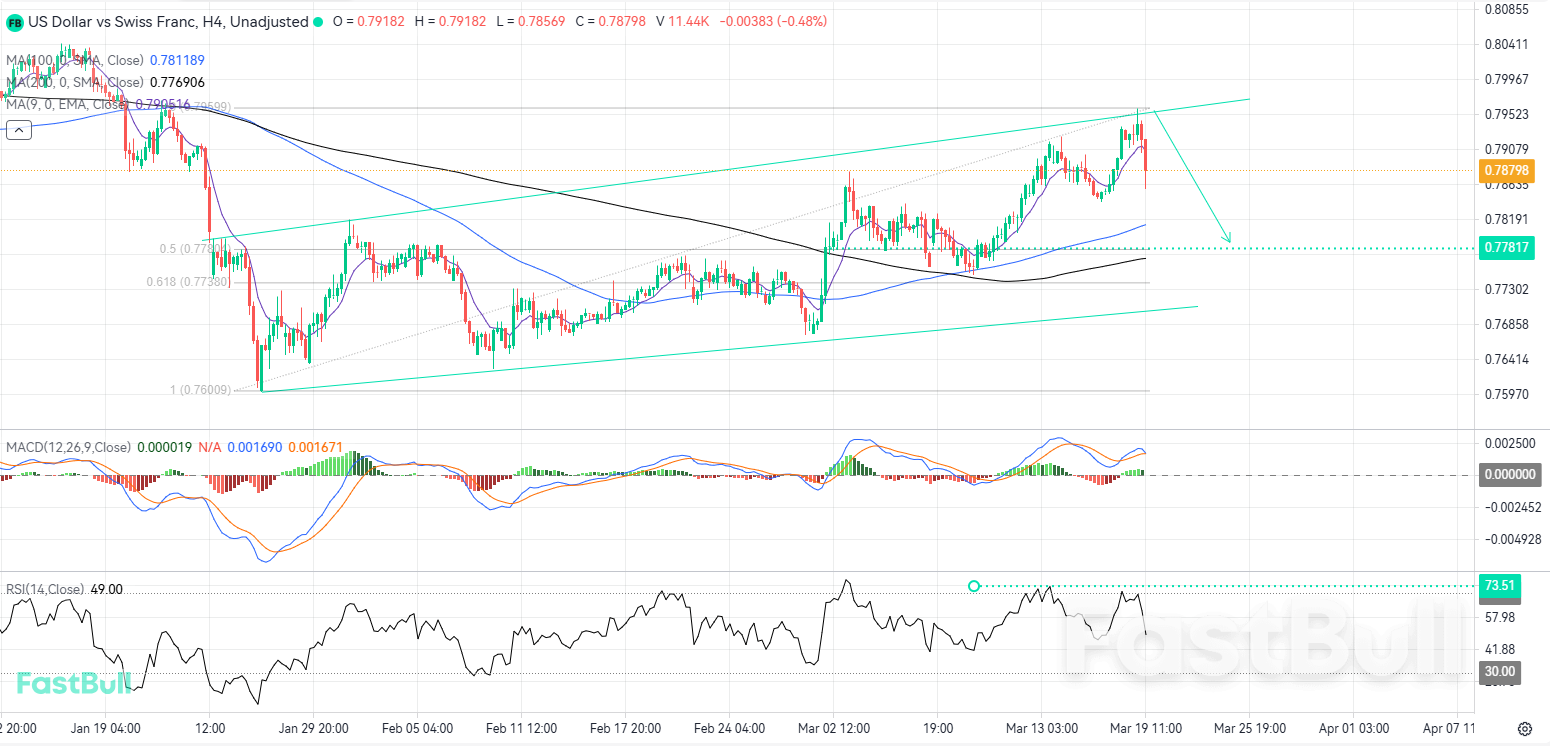
From a technical perspective, USD/CHF has been navigating a well-defined ascending channel. The price action recently executed a sharp rejection upon testing the upper boundary of this structure, suggesting that the pair has reached a point of technical exhaustion. Given that markets typically oscillate between expansionary impulses and corrective phases, a downward retracement appears increasingly probable.
The primary technical objective for this potential correction is the 0.50 Fibonacci retracement level, situated at 0.7781. Furthermore, the 100 and 200-period Moving Averages (MAs) are currently tracking at 0.7812 and 0.7769, respectively. This cluster of dynamic and horizontal support creates a high-confluence zone that is likely to attract buy-side interest during a pullback.
Our analysis of momentum oscillators reinforces the case for a bearish pivot. The RSI recently struck a high of 73, firmly entering overbought territory and inviting sellers to retake control. Simultaneously, the MACD is printing an increasingly anemic bullish histogram.
The shrinking bars on the MACD histogram suggest that a bearish crossover is imminent. Should the signal lines successfully cross beneath the neutral threshold, it would provide the necessary technical validation for a more sustained corrective move toward the moving average cluster.
Trading Recommendations
Trading direction: Sell
Entry price: 0.7880
Target price: 0.7780
Stop loss: 0.7980
Validity: Mar 27, 2026 15:00:00


