Fundamentals
Data released on Wednesday this week indicates that the UK economy faces severe challenges due to the ongoing conflict in the Middle East. The S&P Global UK Construction Purchasing Managers’ Index (PMI) showed that input cost inflation in the construction sector in March recorded the largest month-on-month increase since the survey began in 1997. The indicator measuring cost inflation jumped from 59.5 in February to 70.5, the highest level since November 2022. UK manufacturing data released last week also showed that the rate of increase in cost pressures hit its highest monthly rise since October 1992. New orders in the construction sector fell at the fastest pace since last November, and businesses’ expectations for future output faded once again after showing signs of recovery recently. Although the S&P Global Construction Composite Index remained below the 50.0 growth threshold for the 15th consecutive month, the index rose slightly in March to 45.6 from 44.5 in February. Tim Moore, Chief Economist at S&P Global, stated that infrastructure construction in the energy sector has improved, but the near-term outlook for the sector as a whole remains challenging. Rising inflationary pressures, a gloomy economic outlook and higher borrowing costs are causing concern among executives. Shipping delays caused by disruptions in the Strait of Hormuz have led to a deterioration in supply chain performance for the first time since mid-2025. The all-sector PMI, which includes both manufacturing and services, fell from 52.9 in February to 49.9, the lowest level since September last year.
The US dollar had previously been strengthening due to ongoing geopolitical tensions. The key rationale behind this was that, as a net energy exporter, the US was less affected by soaring oil prices than energy-importing economies such as Europe and Japan. Coupled with the fact that tensions in the Middle East had boosted global demand for safe-haven assets, the US dollar became the preferred safe-haven currency. Following the announcement of the ceasefire agreement, the market anticipated that oil shipments through the Strait of Hormuz would gradually resume. As this waterway accounts for approximately one-fifth of global oil shipments, the easing of energy supply concerns directly triggered a sharp plunge in crude oil prices. New York crude futures fell below $100 per barrel, whilst Brent crude also dropped significantly, with the geopolitical risk premium previously factored into oil prices rapidly dissipating. Juan Perez, Senior Director of Trading at Monex USA, noted that whilst the optimism brought by the ceasefire may be short-lived, current moves to hedge against a March US dollar rebound are justified, as the market is rapidly pricing in the impact of easing geopolitical risks. Jeremy Stretch, Head of G10 FX Strategy at CIBC Capital Markets, cautioned that the ceasefire agreement is fraught with uncertainty and implementation hurdles. Market participation in the relief rally remains limited, and he advised against aggressively shorting the dollar, as a resurgence in geopolitical tensions could still trigger another dollar rally. The decline in energy prices has directly altered market expectations regarding the Federal Reserve’s monetary policy. Previously, soaring oil prices had prompted traders to significantly lower their expectations for Fed rate cuts this year; however, with the sharp drop in oil prices, the market is reassessing inflationary pressures, and the probability of a Fed rate cut before year-end has risen to 50%. These heightened expectations of rate cuts are further weighing on the dollar’s performance.
Technical Analysis
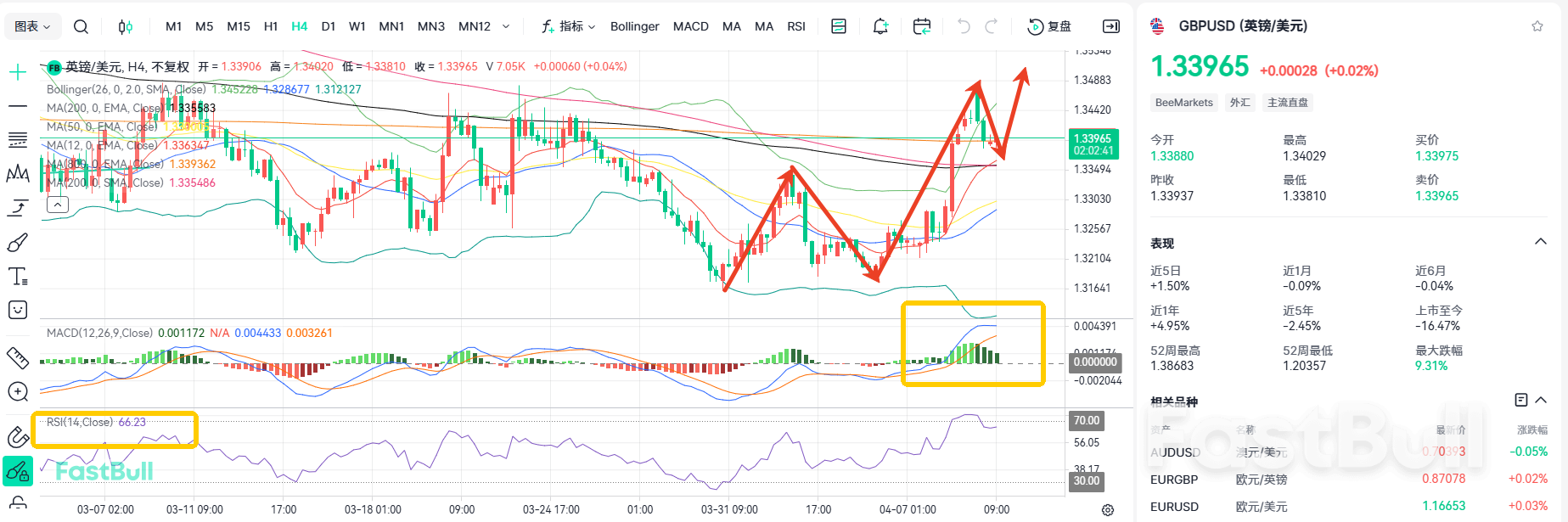
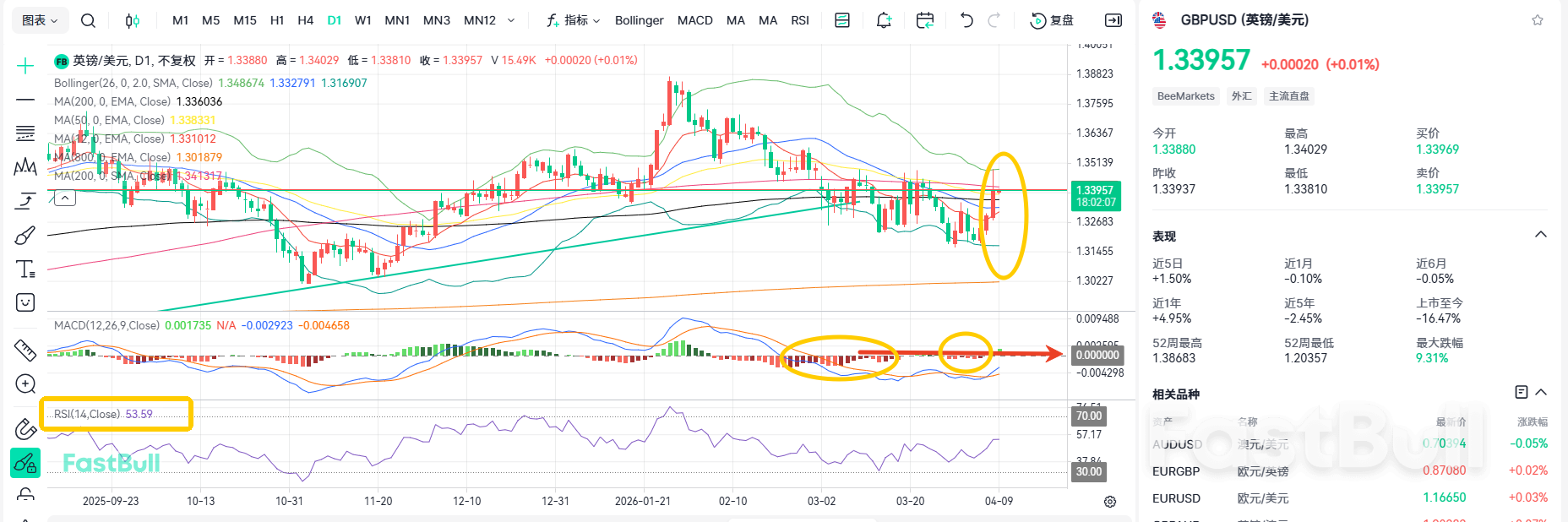
On the daily chart, the GBP/USD pair shows the Bollinger Bands narrowing and moving averages flattening out, suggesting a potential reversal at any moment. Following a bullish crossover on the MACD, the fast and slow lines are retracing towards the 0-line; as they are currently some distance away, this indicates that the rebound is not yet complete. The RSI stands at 53, with market participants adopting a wait-and-see approach. On the four-hour chart, the Bollinger Bands are widening upwards, moving averages are diverging upwards, and the MACD fast and slow lines have returned above the 0-line, indicating that the market has re-entered a bullish zone. The RSI stands at 66, with market participants predominantly buying. The strategy is to buy on dips.
Trading Recommendation
Trading Direction: Buy
Entry Price: 1.337
Target Price: 1.37
Stop-loss: 1.32
Support Levels: 1.32, 1.3, 1.28
Resistance Levels: 1.35, 1.38, 1.41