Late Wednesday, President Trump arrived in Beijing, marking the first state visit to China by an American leader in nine years. This significant diplomatic event comes as the world's two largest economies strive to stabilize bilateral ties through a high-stakes summit staged against the volatile backdrop of the ongoing war in Iran. Both Washington and Beijing are currently evaluating a strategic framework that would enable each nation to identify approximately $30 billion worth of goods eligible for significant tariff reductions—specifically focusing on sectors that do not compromise national security interests.
On the domestic front, the Bureau of Labor Statistics (BLS) reported that inflation, as measured by the Consumer Price Index (CPI), accelerated to a 3.8% year-over-year expansion in April. This figure exceeded the previous 3.3% print and overshot market forecasts of 3.7%. On a month-over-month basis, the CPI rose by 0.6%, aligning with analyst expectations. However, Core CPI—which strips out volatile food and energy costs—ascended to 2.8% year-over-year from its prior 2.6%, also surpassing the consensus estimate of 2.7%.
The report underscored that energy prices were a primary catalyst, surging by 3.8% in April and accounting for over 40% of the headline index’s monthly increase. Coupled with rising shelter and food costs, these figures have intensified concerns regarding the persistence of inflationary pressures within the U.S. economy. Meanwhile, labor metrics provided a nuanced view; weekly ADP data showed that private-sector employers added an average of 33,000 jobs per week over the four weeks ending April 25, signaling a modest yet steady improvement in labor market momentum.
Chicago Fed President Austan Goolsbee added to the hawkish narrative during his remarks at the Greater Rockford Chamber of Commerce on Tuesday. He warned that the absence of central bank independence would likely lead to a forceful resurgence of inflation, emphasizing the structural necessity of the Federal Reserve's autonomy in maintaining price stability.
Across the border, data released by Statistics Canada revealed a sharp and unexpected contraction in the domestic labor market. The Net Change in Employment plummeted by 17,700 positions in April, significantly underperforming the anticipated 15,000 gain and effectively erasing the 14,100 expansion recorded in March. Consequently, the Unemployment Rate ascended to 6.9% from its prior 6.7% print, while average hourly wages moderated to a 4.8% year-over-year pace, down from the 5.1% observed in the preceding month.
This burgeoning slack within the Canadian labor landscape may compel the Bank of Canada (BoC) to critically re-examine its current monetary policy trajectory. Such a cooling in employment metrics potentially restricts the central bank’s capacity to implement further restrictive measures, even if energy-driven inflationary pressures continue to intensify globally. Despite this softening in the "real" economy, the swaps curve remains aggressively priced, discounting more than 50 basis points of rate hikes over the coming twelve months, targeting a terminal rate of 2.75%.
Technical Analysis
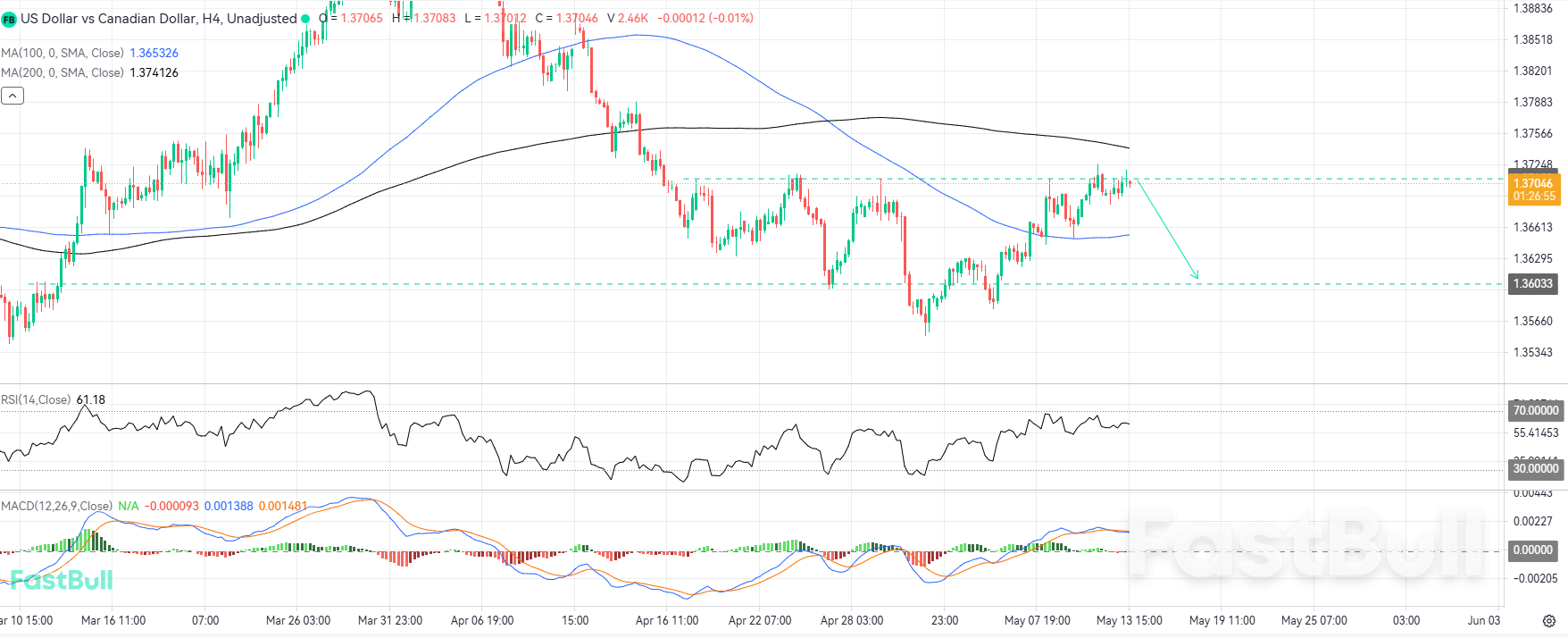
From a technical perspective, USD/CAD has encountered a formidable resistance handle at 1.3710, a level that has successfully thwarted multiple breakout attempts in recent sessions. Should the current bearish rejection persist at this psychological and structural threshold, we may witness the inception of a corrective move lower.
Specifically, the pair staged a notable rebound after striking local lows of 1.3551 on May 1st, reaching a peak of 1.3726 in the previous session. This rally has brought price action into close proximity with the 200-period Moving Average (MA), which is currently situated at 1.3741. Meanwhile, the 100-period MA tracks lower at 1.3653. A failure to decisively breach the 1.3710–1.3741 resistance zone would likely favor a mean-reversion move toward the 1.3603 handle, which represents the next major support zone.
Our analysis of momentum oscillators provides further confirmation of this potential pivot. The Relative Strength Index (RSI) is currently hovering at the 60 level, having repeatedly touched near-overbought territory as the pair challenged the resistance ceiling. Simultaneously, the MACD histogram is displaying a nascent bearish bias, though it remains notably shallow at this stage.
For the bearish impulse to gain sustainable traction, the MACD histogram must expand in depth, and the signal lines must transition below the neutral threshold. Conversely, a decisive daily close above the current resistance cluster would invalidate this bearish setup and open the door for extended gains toward the next structural supply zone.
Trading Recommendations
Trading direction: Sell
Entry price: 1.3710
Target price: 1.3603
Stop loss: 1.3760
Validity: May 26, 2026 15:00:00


