The Bank of Canada (BoC) recently elected to anchor its benchmark overnight rate at 2.25%—a level that has remained unchanged since October. During the post-meeting press conference, Governor Tiff Macklem signaled that the Governing Council remains prepared to implement further tightening should energy-driven costs translate into persistent, broad-based inflationary pressures. Conversely, he maintained a degree of strategic optionality, suggesting that rate cuts remain on the table if energy prices retreat and broader economic activity exhibits further signs of deceleration.
In the official communiqué, Macklem emphasized that elevated levels of uncertainty continue to plague the outlook, primarily driven by shifting U.S. trade policy and heightened geopolitical risks. Specifically, he warned that the Middle Eastern conflict is driving crude prices higher, which could trigger an immediate, short-term inflationary spike. While higher oil prices historically bolster Canada’s energy export revenues, Macklem cautioned that this macro benefit is often offset by increased costs for domestic consumers, which effectively curtails discretionary spending across other vital sectors of the economy. Ultimately, the BoC indicated a preference to "look through" the transitory inflationary effects of the conflict, provided they do not become entrenched.
This delicate monetary balance is being tested by a significant escalation in regional tensions. Reports that the U.S. Pentagon is deploying an additional 10,000 troops to the Middle East have intensified fears of a broadening conflict. In response, Iranian Brigadier General Ebrahim Zolfaqari issued a blunt warning on state television, asserting that "American troops will serve as bait for the sharks of the Persian Gulf." Reinforcing this hostile stance, Parliament Speaker Mohammad Bagher Ghalibaf warned that Iran would "rain fire" upon any U.S. forces attempting to enter Iranian territory, pushing the region closer to a full-scale confrontation.
On the domestic front, the United States continues to demonstrate remarkable labor market resilience. The Department of Labor reported that initial jobless claims for the week ending March 21 settled at 210,000, aligning with analyst consensus and following a previous print of 205,000. However, this employment stability is sharply contrasted by persistent inflationary headwinds. Import prices surged by 1.3% in February—the most aggressive spike since March 2022—primarily driven by escalating energy costs prior to the regional conflict.
Compounding these concerns, S&P Global recently noted that U.S. enterprises are grappling with elevated input costs throughout March, exacerbated by volatile energy expenditures and localized supply chain bottlenecks. Looking ahead, the U.S. economic calendar is packed with high-impact releases, most notably the Non-Farm Payrolls (NFP) data. This report is expected to exert significant influence over the Federal Reserve’s (Fed) monetary policy outlook as the central bank navigates the line between growth and price stability.
Technical Analysis
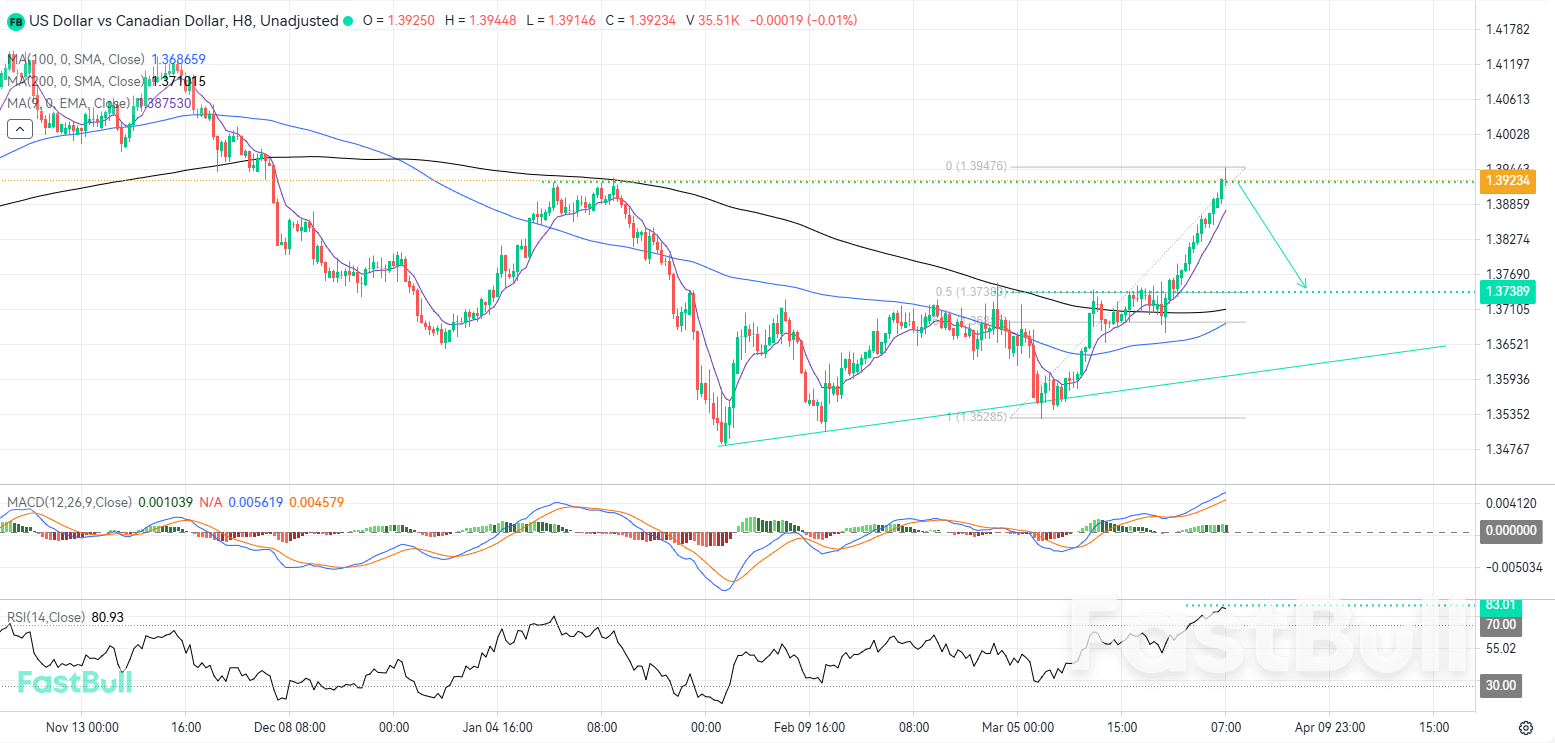
From a technical perspective, USD/CAD has recently exhibited a powerful bullish impulse, reaching a critical resistance ceiling at 1.3929—levels not witnessed since January 16. It is worth noting that this same structural level triggered a sharp bearish rejection earlier this year. Should we witness a similar reaction in the current session, with price action returning beneath this supply wall, it could catalyze a corrective downward move toward the 1.3738 support zone.
This downside objective is of high technical significance as it aligns perfectly with the 0.50 Fibonacci retracement level. Furthermore, the 100 and 200-period Moving Averages (MAs) are currently tracking at 1.3686 and 1.3710, respectively. The proximity of these dynamic averages to the primary Fibonacci target creates a high-confluence floor that adds significant weight to a potential mean-reversion move toward this area.
Our analysis of momentum oscillators reinforces the case for a bearish pivot. The RSI on the 8-hour chart recently struck a high of 83, moving into extreme overbought territory and signaling significant technical exhaustion. Simultaneously, the MACD is printing a bullish histogram that has failed to gain proportional depth, suggesting that the current move is overextended and susceptible to a reversal.
A transition into a negative histogram, accompanied by a bearish signal line crossover, would provide the definitive technical confirmation for a sustained corrective impulse. Given the rejection at the January highs, the path of least resistance currently favors a tactical retracement toward structural support.
Trading Recommendations
Trading direction: Sell
Entry price: 1.3926
Target price: 1.3740
Stop loss: 1.4050
Validity: Apr 10, 2026 15:00:00


