The ZEW Economic Sentiment Survey came in well below expectations, with both Germany and the Eurozone reporting weaker readings in October. Germany’s economic sentiment indicator declined to 28.1 points from 34.7 in September, missing the consensus forecast of 32. Meanwhile, the Eurozone index fell to 18.5 from 25.8, significantly below the 24.2 expected by the market. The deterioration in both readings suggests that concerns about the economic outlook are weighing on investor sentiment, adding to the challenges facing the European Central Bank as it attempts to manage persistent inflationary pressures without undermining economic activity.
ECB President Christine Lagarde said on Saturday that “while growth has proven resilient, financing conditions have tightened.” Her comments highlight the difficulty of addressing inflation driven by higher energy prices while maintaining support for the broader economy. Tighter financing conditions could weigh on investment and consumption, particularly if borrowing costs remain elevated, creating an additional challenge for policymakers as they assess the appropriate direction of monetary policy.
Final data released on Friday showed that the Eurozone Harmonised Index of Consumer Prices (HICP) increased by 3.8% year over year in September, while core HICP inflation rose by 2.5%. The figures confirm that headline inflation remains elevated, even as underlying price pressures are more moderate. This divergence complicates the ECB’s policy outlook, as the central bank must determine how much of the recent inflation increase reflects energy costs and how much could become more persistent across the wider economy.
ECB officials remain divided over the pace of any further monetary tightening. Some policymakers argue that the second-round effects of higher oil prices remain limited, while growing downside risks to economic growth could make additional rate increases difficult to justify. Others warn that persistent inflation could require further tightening to prevent price pressures from becoming entrenched. This difference in views leaves the outlook for interest rates uncertain, with future decisions likely to depend on whether inflation remains elevated and how significantly tighter financing conditions affect economic activity.
Meanwhile, the situation in France has added to investor concerns, following reports and images of severe violence during student protests over the weekend. Demonstrations escalated in several major French cities, resulting in property damage and looting. Police reportedly made 1,800 arrests, while Interior Minister Laurent Nunez submitted his resignation, which President Emmanuel Macron rejected. The unrest adds another source of uncertainty to the French outlook, at a time when investors are already monitoring the country’s political and economic challenges and their potential implications for the broader Eurozone.
Swiss National Bank (SNB) Vice Chairman Antoine Martin recently stated that the economic outlook remains subject to a significant degree of uncertainty. However, Martin ruled out interest rate increases in the near term, noting that “we remain comfortably within the 0% to 2% price stability range.” His comments suggest that the current inflation environment does not justify an immediate adjustment to monetary policy, even as uncertainty surrounding global economic conditions and energy prices continues to influence the outlook.
The SNB continues to maintain its policy rate at 0%, with the threshold for a potential rate increase appearing relatively high as inflation remains within its 0% to 2% price stability range. This gives the central bank room to maintain its current stance while assessing incoming economic data and the evolution of inflation. Unless price pressures rise meaningfully or the inflation outlook changes, an immediate shift toward tighter monetary policy appears unlikely based on the latest comments from policymakers.
Technical Analysis
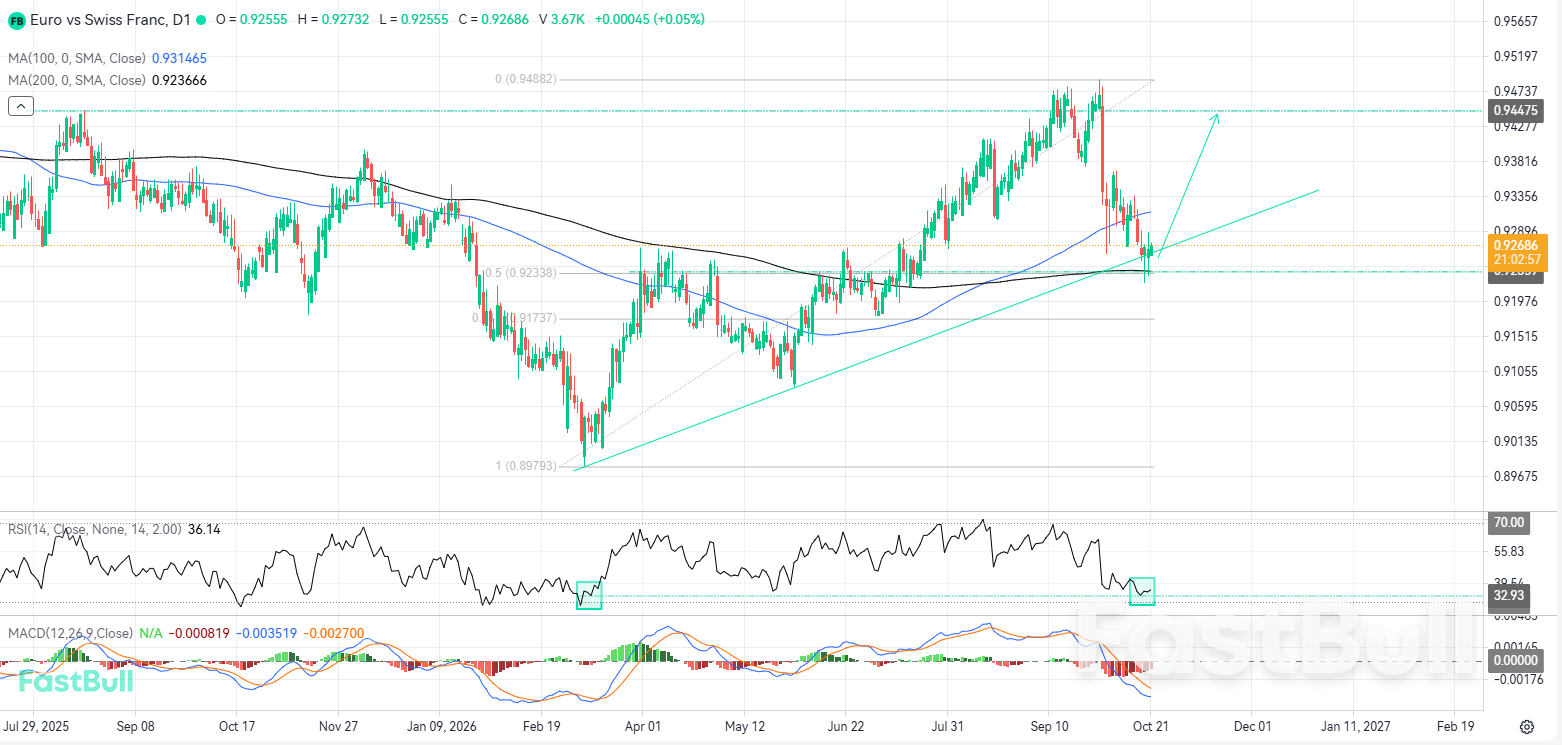
EURCHF recently rebounded after reaching the 200-period moving average, which aligns with local support at 0.9236. The bullish rejection from this area quickly pushed the pair back above its ascending trendline, suggesting that buyers are attempting to regain control after the recent corrective decline. Although further consolidation may be needed over the coming sessions to confirm that the recovery can be sustained, a successful defense of this support zone could offer opportunities to join the prevailing uptrend. The technical case for a potential continuation is reinforced by the fact that the support level also coincides with the 0.50 Fibonacci retracement, adding further significance to the area as a possible turning point for the current pullback.
Looking at the oscillators, the RSI is currently near 36 after recently approaching oversold territory at around 32. These readings are notable because the RSI had not reached similar levels since early March, when prices were trading close to local lows. The subsequent rebound suggests that bearish momentum may be weakening, although further confirmation from price action would be needed before considering the recovery established. Meanwhile, the MACD shows a bearish histogram that has started to lose depth rapidly, raising the possibility of a transition toward positive momentum if support continues to hold. The signal lines, however, remain in bearish territory, meaning that a bullish crossover would provide additional confirmation and could accelerate the recovery. If EURCHF maintains support at 0.9236 and the oscillators continue to improve, the pair could regain upward momentum and resume its broader bullish trend.
Trading Recommendations
Trading direction: Buy
Entry price: 0.9268
Target price: 0.9447
Stop loss: 0.9160
Validity: Oct 30, 2026 15:00:00


