On Wednesday, the latest inflationary data from Australia confirmed a largely stable trajectory throughout February, providing a much-needed measure of relief for domestic households. The Consumer Price Index (CPI) exhibited a marginal moderation, retreating from 3.8% to 3.7% year-over-year. Despite this welcome cooling, the headline figure remains stubbornly entrenched above the Reserve Bank of Australia’s (RBA) mandated 3% target.
Concurrently, the underlying measure—the trimmed mean CPI—settled at 3.3% year-over-year, remaining unchanged from January’s figure, which was itself revised downward from an initial 3.4%. It is crucial for market participants to note that these figures were tabulated prior to the recent escalation of hostilities in the Middle East—a conflict that has since propelled global energy costs higher and intensified systemic inflationary risks.
In this volatile environment, RBA Deputy Governor Christopher Kent recently observed that the conflict involving Iran has contributed to a tightening of global financial conditions. He underscored that such supply-side shocks represent a primary risk to the disinflationary process. Kent clarified that while central banks lack the direct tools to prevent the immediate impact of these shocks, they must act decisively to ensure that localized price spikes do not manifest as long-term inflationary expectations or more persistent price pressures. Regarding monetary policy, the RBA elevated the cash rate to 4.1% last week following a narrowly contested vote. Governor Michele Bullock characterized the decision as a strategic matter of timing rather than a fundamental pivot in the bank’s broader policy orientation.
Across the Atlantic, the Swiss National Bank (SNB) maintained its primary policy rate at 0.00% during its March deliberations, fulfilling broader market forecasts. However, the most striking development from the session was the bank’s significant shift in foreign exchange guidance. Citing the intensifying regional conflict, the SNB signaled a heightened readiness to intervene in the currency markets. This strategic pivot is specifically designed to thwart any rapid or excessive appreciation of the Swiss Franc (CHF), which policymakers believe could undermine domestic price stability and exacerbate deflationary pressures.
During the subsequent press conference, Chairman Martin Schlegel clarified that the existing regulatory agreement between Switzerland and the United States permits the SNB to participate in the FX market, provided such actions do not seek an unfair competitive advantage. Despite this transparency, specific data regarding first-quarter interventions will remain undisclosed until late June. Currently, inflation in Switzerland remains exceptionally subdued, printing at just 0.1% year-over-year in February. This weakness is largely attributed to a multi-year decline in the price of imported goods—a trend sustained by the historical structural strength of the Franc.
Technical Analysis
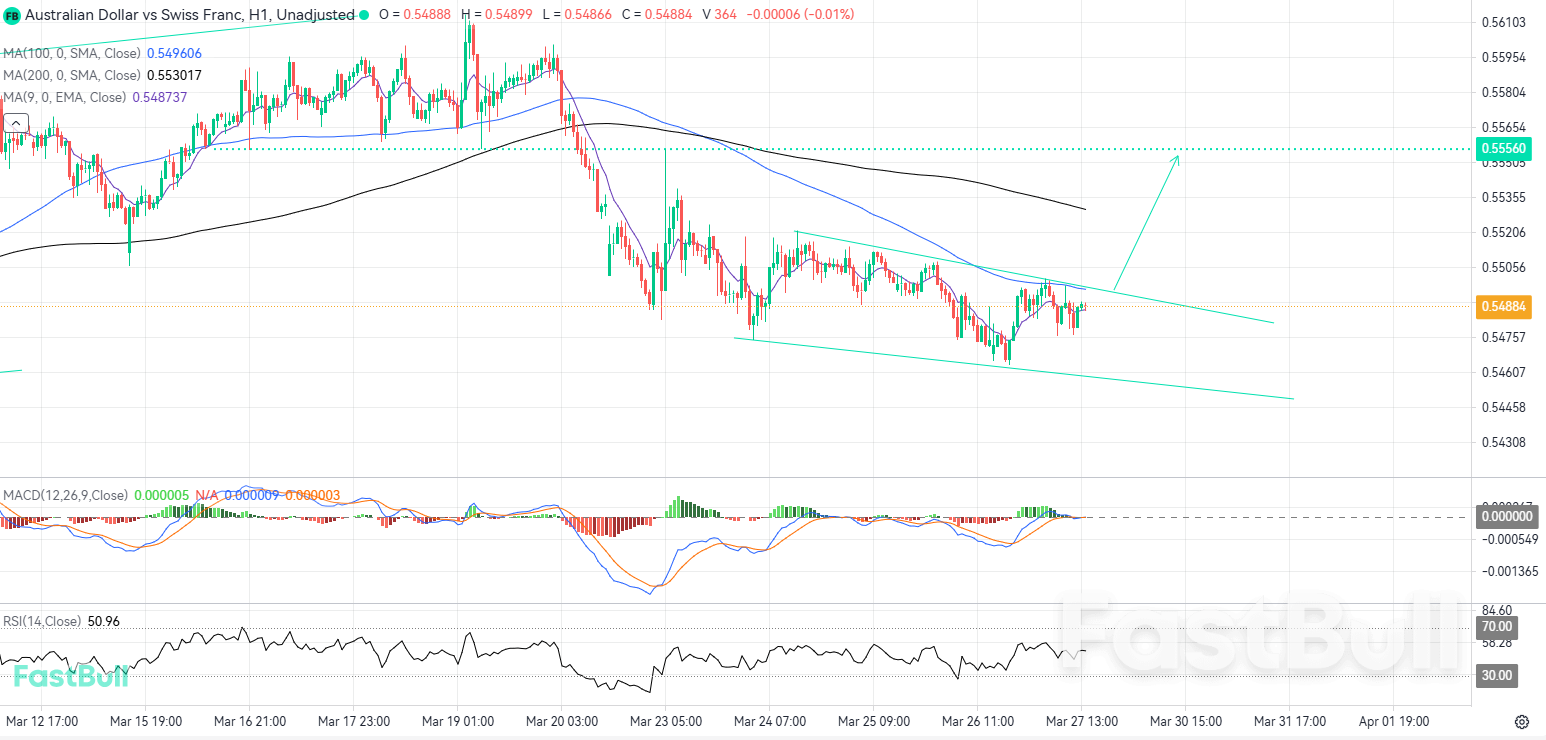
From a technical perspective, AUD/CHF is currently navigating a classic descending wedge formation—a structural pattern that can precedes a bullish breakout. At present, price action is exhibiting a minor bearish rejection from the 100-period Moving Average (MA), situated at 0.5496. Meanwhile, the 200-period MA sits slightly higher at 0.5530, creating a narrow corridor of dynamic resistance.
Should the pair successfully achieve a decisive close above the 100-period MA, it would likely catalyze a breakout from the wedge’s upper boundary. Such a move would clear the path for a renewed bullish impulse, with primary objectives targeted at the 0.5556 handle, which represents the next major structural resistance zone.
Our analysis of momentum oscillators provides further validation for an upside bias. The Relative Strength Index (RSI) is currently tracking at 51, maintaining a neutral posture that offers sufficient "runway" for an extended upward move before reaching overbought extremes. Simultaneously, the MACD signal lines are in the process of crossing above the neutral threshold into bullish territory.
While the signal lines are trending higher, the move requires the MACD histogram to regain positive depth to confirm the shift in momentum. A convergence of a price breakout above 0.5496 and a deepening positive histogram would provide the final confirmation for a sustained rally toward the 0.5556 ceiling.
Trading Recommendations
Trading direction: Buy
Entry price: 0.5488
Target price: 0.5556
Stop loss: 0.5450
Validity: Apr 07, 2026 15:00:00


