In the Eurozone, Industrial Production extended its decline after contracting for the third consecutive month in August. Meanwhile, final Harmonised Index of Consumer Prices (HICP) data released last week confirmed that annual inflation accelerated to 3.8% in September, reaching its highest level in three years. The combination of rising prices and weakening industrial activity has intensified concerns about stagflation, leaving the European Central Bank (ECB) facing a difficult balance between controlling inflation and avoiding additional pressure on economic growth.
ECB officials remain divided over the need for further monetary tightening and the pace at which it should be implemented. Some policymakers argue that the second-round effects of higher oil prices remain limited, while growing downside risks to economic activity could make additional rate increases difficult to justify. Others maintain that persistent inflation may require further tightening to prevent price pressures from becoming entrenched. This divergence in views continues to create uncertainty around the monetary policy outlook, with upcoming decisions likely to depend on how inflation and economic activity develop over the coming months.
Meanwhile, Iran has renewed its offer to reopen the Strait of Hormuz within seven days, provided Washington accepts its conditions, although negotiations remain stalled over Tehran’s nuclear program. Continued attacks on vessels in the strait, along with clashes between Saudi Arabia and the Houthis, are keeping risks to energy supplies elevated. However, US President Donald Trump’s decision to temporarily suspend sanctions on Russia has raised expectations that additional energy supplies could reach the market, potentially easing some of the upward pressure on prices. These opposing developments continue to complicate the outlook for energy markets and their potential impact on global inflation.
In the United States, elevated energy prices linked to the war in the Middle East continue to contribute to inflationary pressures, with both the September Consumer Price Index (CPI) and Producer Price Index (PPI) reports coming in above expectations. The stronger-than-expected figures have reinforced expectations of another interest rate increase before the end of the year as the Federal Reserve seeks to bring inflation back toward its 2% target. If energy costs remain elevated and continue to affect broader consumer prices and production expenses, the central bank could face additional challenges in bringing inflation under control without further tightening monetary policy.
Recent comments from Fed officials also suggest that policymakers remain open to additional tightening, although they have not firmly indicated that rates will be raised at the October 27–28 meeting. Speaking in Bangkok on Friday, Fed Chair Kevin Warsh maintained his position of avoiding forward guidance, stating, “I do not prejudge meetings.” His remarks leave the timing of any potential rate increase uncertain, reinforcing the importance of upcoming economic releases and inflation data in shaping expectations for the Fed’s next policy decision.
US Treasury yields moved higher as investors assessed the latest inflation figures and their potential implications for monetary policy. The two-year Treasury yield, which is particularly sensitive to expectations for the Fed’s short-term interest rate decisions, increased by more than 3 basis points (bps) to 4.778%. The 10-year Treasury yield also rose by more than 4 bps to 5.144%, while the 30-year yield gained more than 4 bps, reaching 5.476%. The increase across maturities reflects continued pressure on the bond market as investors weigh the possibility of persistent inflation and higher borrowing costs.
Technical Analysis
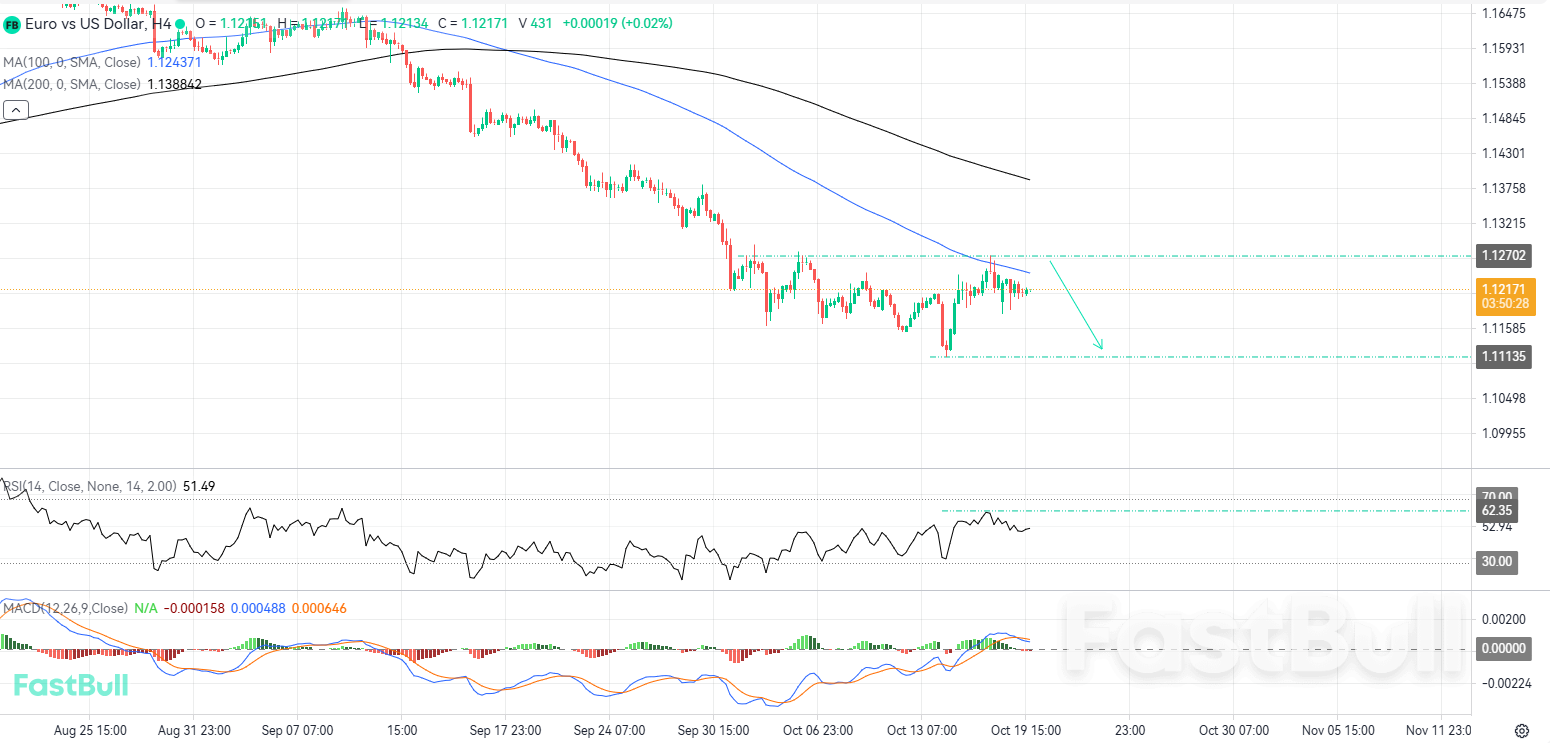
EURUSD recently reached the local resistance level at 1.1270 after recovering from local lows near 1.1113 on October 14. During this rebound, the pair advanced toward the 100-period moving average, currently positioned at 1.1283, where it encountered resistance and reversed lower. The fact that both the horizontal resistance level and the moving average have restricted the recovery highlights the importance of this area for the pair’s near-term direction. If EURUSD fails to break decisively above this zone and continues to show bearish price action, the rejection could offer opportunities to enter short positions in line with the prevailing downtrend, initially targeting the recent lows and potentially a further break to the downside.
Looking at the oscillators, the RSI recently reached 62, reflecting a sharp increase in momentum despite only a marginal advance in price. This divergence between the indicator and price action could suggest that the bullish recovery is losing strength, increasing the possibility that sellers will regain control. Meanwhile, the MACD histogram has recently turned bearish and could begin to expand further, which would support the possibility of renewed downside momentum. The signal lines remain slightly above the neutral zone, but a quick move back into bearish territory would provide additional confirmation that selling pressure is strengthening. Taken together, a sustained rejection at resistance, accompanied by weakening bullish momentum and a more pronounced bearish MACD histogram, could increase the likelihood of EURUSD resuming its decline toward recent lows and potentially breaking below them.
Trading Recommendations
Trading direction: Sell
Entry price: 1.1270
Target price: 1.1115
Stop loss: 1.1335
Validity: Oct 30, 2026 15:00:00


